
How to Build a Portfolio With No Experience: Artist & Designer Guide
If you're trying to figure out how to build a portfolio with no experience, you don't need to wait until you've landed paying clients. Artists and designers can build credible portfolios with personal projects, self-initiated briefs, school projects, volunteer work, redesign exercises, and carefully developed concept projects.
The goal isn't to make yourself appear more experienced than you are.
The goal is to show what you're capable of creating when given an opportunity.
Advertisement
How to Build a Portfolio With No Experience
The best way to build a portfolio with no experience is to create projects that demonstrate the same skills a real client or employer would expect you to use.
Start by deciding what kind of work you want to be hired to create. Then build approximately five to eight strong projects around those skills.
Your portfolio might include:
- Personal projects
- Self-initiated creative briefs
- School projects
- Volunteer work
- Brand concepts
- Editorial illustrations
- Character designs
- Packaging concepts
- Poster designs
- Website concepts
- Art series
- Photography projects
Clearly identify work as personal, conceptual, student, or self-initiated when appropriate.
You don't need to pretend fictional projects were commissioned by real companies.
Why Can Building Your First Portfolio Feel So Difficult?
Beginning artists and designers often encounter a frustrating problem:
You need experience to get clients, but you need clients to get experience.
Fortunately, those aren't actually the same thing.
You need work to show before you need professional client work to show.
Your first portfolio can demonstrate:
- Technical ability
- Creativity
- Visual judgment
- Problem solving
- Communication
- Art direction
- Creative process
- Consistency
- Attention to detail
Think of your portfolio as evidence of what you could do next rather than simply a record of what you've already been paid to do.
Build the Portfolio for the Work You Want
Before creating anything, ask yourself:
What do I actually want someone to hire me to create?
If you want branding projects, show branding.
If you want editorial illustration work, create editorial illustrations.
If you want character-design work, show characters.
If you want album-cover work, create album-cover concepts.
Your portfolio sends a signal about your creative direction.
The work you show effectively tells potential clients:
This is what I do.
That doesn't mean every project needs to look identical.
It means someone should be able to understand your creative direction fairly quickly.
If you're still developing that direction, work through the exercises in How to Find Your Art Style: 10 Exercises for Artists.
Step 1: Choose Your Portfolio Direction
Start by identifying one to three areas you'd genuinely like to pursue professionally.
Graphic Designers
You might focus on:
- Branding
- Packaging
- Editorial design
- Advertising
- Web design
Illustrators
You might focus on:
- Editorial illustration
- Character design
- Book covers
- Posters
- Narrative illustration
Digital Artists
You might focus on:
- Character illustration
- Environment art
- Concept art
- Portraiture
- Visual development
If you're just getting started digitally, read How to Start Digital Art: A Complete Beginner's Guide.
Avoid trying to prove that you can do absolutely everything.
A focused portfolio is usually easier for potential clients and employers to understand.
Step 2: Create Your Own Briefs
No clients?
Give yourself an assignment.
Instead of saying:
"I'm going to design a cool coffee logo."
Create an actual problem to solve.
For example:
Example Portfolio Brief
Client: Fictional specialty coffee company
Audience: Young urban professionals interested in specialty coffee
Problem: The company needs to appeal to younger customers while maintaining a handcrafted identity.
Deliverables:
- Logo
- Packaging
- Coffee bag design
- Color palette
- Typography
- Instagram graphics
- Store signage
Now you're doing more than designing a logo.
You're solving a visual communication problem.
That's much closer to professional creative work.
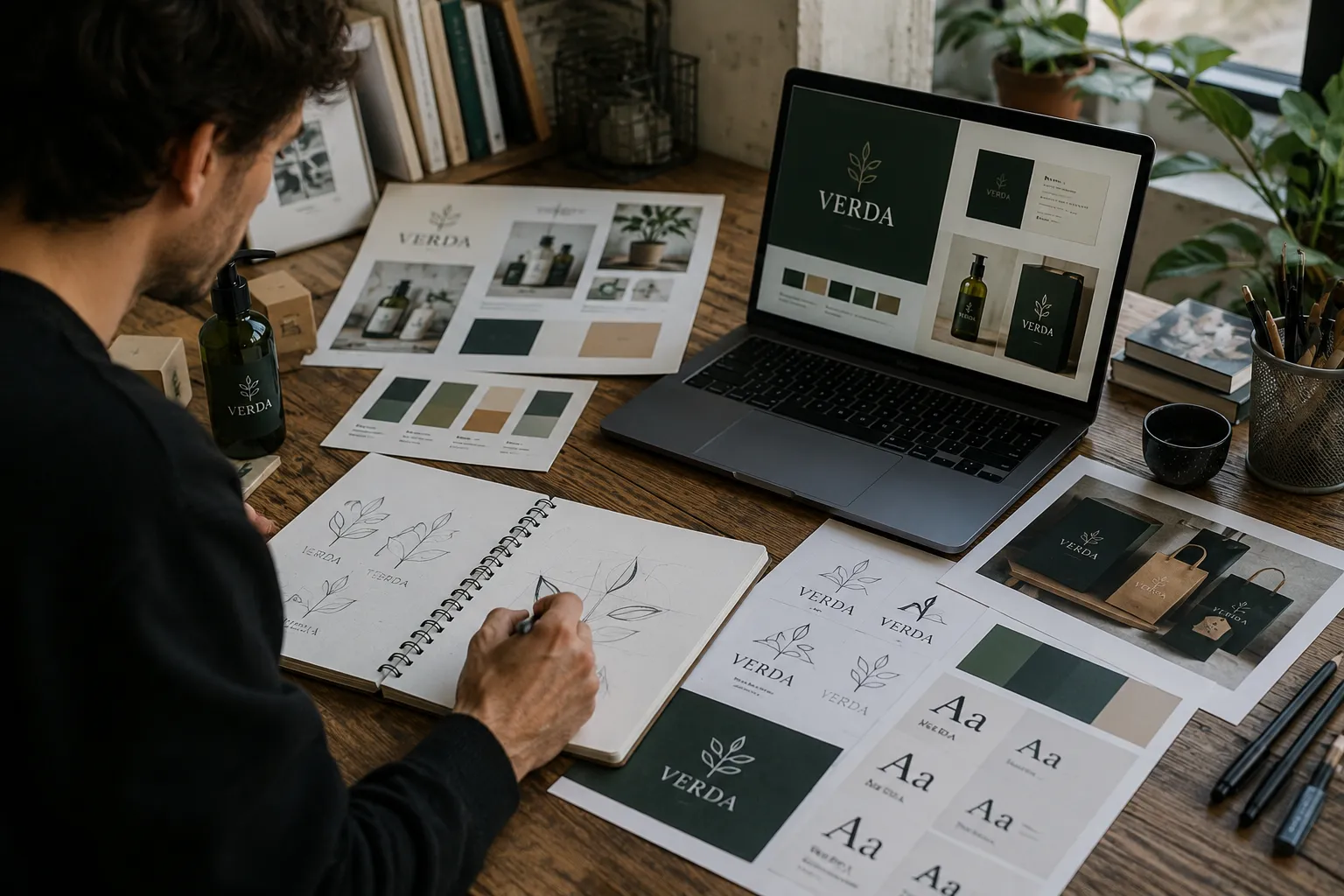
Step 3: Turn Projects Into Case Studies
Don't make your portfolio nothing more than a gallery of finished images.
For your strongest projects, explain:
- The problem
- The audience
- Your objective
- Your approach
- Your creative process
- Your solution
- What you learned
A simple portfolio case study could look like this:
Project
Independent Coffee Brand Identity
The Brief
Create a visual identity for a fictional specialty coffee company targeting younger urban customers.
The Challenge
Create a premium identity without making the company feel corporate.
Research
- Competitor analysis
- Mood boards
- Audience research
- Visual references
Creative Process
- Sketches
- Logo concepts
- Typography exploration
- Color exploration
- Packaging iterations
Final Solution
- Logo
- Packaging
- Social graphics
- Signage
- Brand system
What I Learned
Explain what you discovered while developing the project and what you might approach differently next time.
This tells a much stronger story than simply uploading:
logo-final.jpg
Step 4: Make Your Projects Feel Real
Concept work becomes more convincing when viewers can see how the design might function in the real world.
Instead of displaying only a logo, show it applied to:
- Packaging
- Business cards
- Websites
- Posters
- Social media
- Mobile interfaces
- Clothing
- Books
- Products
- Environmental signage
Mockups can help communicate context.
However, don't let elaborate mockups hide mediocre design.
Show both:
The actual design
and
The design being used.
Step 5: Use Personal Projects Strategically
Personal projects aren't automatically inferior to client projects.
They can actually provide more creative freedom.
Give yourself professional constraints such as:
- A deadline
- Specific deliverables
- An audience
- A creative objective
- Technical limitations
Then finish the project.
Don't abandon it when the exciting part is over.
Finishing projects is part of developing professional creative habits.
How Many Projects Should a Beginner Portfolio Have?
A beginner should generally prioritize five to eight excellent projects rather than 15 mediocre ones.
You don't receive bonus points for filling every available space.
Think:
5–8 strong projects
instead of:
Everything I've created since I started making art.
Your weakest project can influence how someone perceives the rest of your portfolio.
Before including something, ask:
Would I want someone to hire me to create more work like this?
If the answer is no, reconsider including it.
What Should a Graphic Designer Put in a Portfolio?
A beginner graphic designer could build a portfolio around projects such as:
Project 1: Brand Identity
Create:
- Logo
- Typography
- Color system
- Brand guidelines
- Applications
Project 2: Packaging Design
Create:
- Product packaging
- Labels
- Product variations
- Shelf mockups
Project 3: Editorial Design
Create:
- Magazine cover
- Article spread
- Typography system
- Supporting graphics
Project 4: Advertising Campaign
Create:
- Poster
- Digital advertisements
- Social-media graphics
- Billboard concept
Project 5: Website
Create:
- Homepage
- Interior page
- Desktop design
- Mobile design
- UI components
Project 6: Personal Project
Create something based primarily on your own creative interests.
This can help show personality that might not appear in commercial-style assignments.
What Should an Illustrator Put in a Portfolio?
Illustrators might include:
- Editorial illustration
- Book cover
- Character design
- Narrative scene
- Poster illustration
- Product illustration
- Portrait
- Sequential illustration
- Personal art series
You can demonstrate range without making your portfolio feel completely random.
Artists interested in character or concept work may also benefit from studying Human Anatomy for Artists.
Can School Projects Go in a Professional Portfolio?
Yes.
A strong project doesn't suddenly become bad because it started as a class assignment.
Ask:
- Does this represent my current ability?
- Does it fit the work I want?
- Is the concept strong?
- Is the execution polished?
- Can I explain my decisions?
If the answer is yes, consider keeping it.
If you've improved considerably since completing the project, revisit it.
You might improve:
- Typography
- Presentation
- Mockups
- Photography
- Case-study writing
You don't necessarily need to redesign everything.
Should You Redesign Existing Brands?
You can, but give the redesign a purpose.
Simply saying:
"I redesigned this famous logo because I didn't like it."
doesn't demonstrate much strategic thinking.
Instead, establish a problem.
For example:
Create a packaging concept for an established beverage company introducing a zero-waste product line aimed at younger consumers.
Now your creative decisions have context.
Clearly identify the project as:
Unofficial
Conceptual
or
Self-initiated
Never imply that a real company hired you when it didn't.
Can You Use Fictional Clients?
Absolutely.
There's a major difference between creating a fictional client and making a false claim about professional experience.
For example:
Northline Coffee
Project type: Fictional brand concept
Audience: Specialty coffee customers ages 25–40
Brand personality: Modern, warm, independent
Problem: Create packaging capable of differentiating the brand in a crowded specialty-coffee market.
This gives you realistic constraints without pretending Northline Coffee actually hired you.
How Much Process Should You Show?
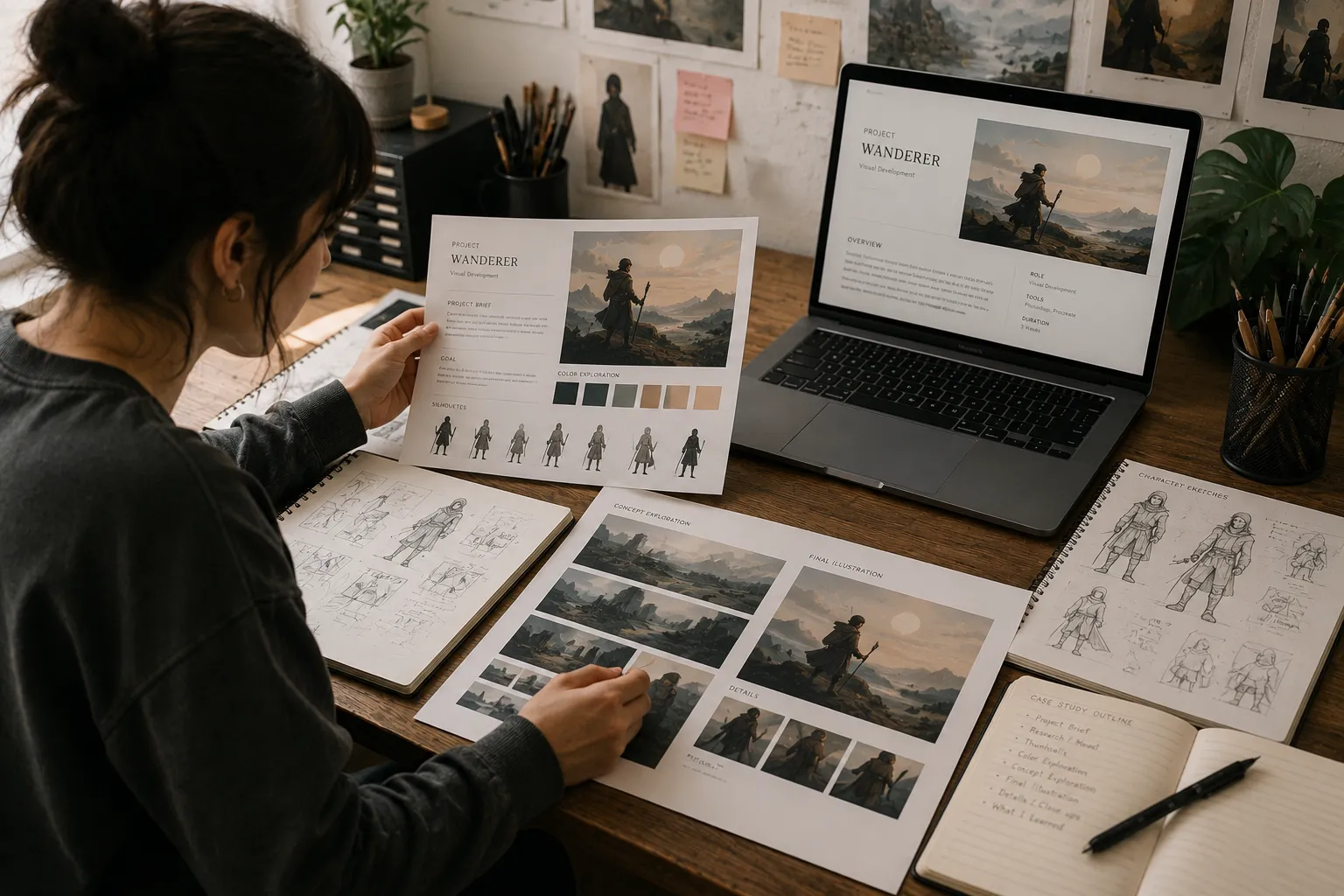
Show enough process to explain your thinking without overwhelming the viewer.
Consider showing:
- Initial sketches
- Mood boards
- Early concepts
- Rejected directions
- Color exploration
- Typography experiments
- Iterations
- Final system
The objective isn't to prove that you worked hard.
It's to demonstrate how you think.
What Should Every Portfolio Case Study Include?
A strong case study should answer several basic questions.
What Was the Problem?
Why did the project need to exist?
Who Was It For?
Identify the intended audience.
What Was Your Role?
This is especially important for collaborative projects.
What Did You Create?
Explain the deliverables.
Why Did You Make Those Decisions?
Show the reasoning behind your work.
What Was the Result?
For real projects, include measurable outcomes when they're available.
For fictional projects, don't invent results.
Explain what the proposed solution was designed to accomplish instead.
Should You Put Unfinished Work in Your Portfolio?
Usually, no.
Your main professional portfolio should emphasize resolved work.
Experiments, sketches, and unfinished ideas can still be useful elsewhere, such as:
- Sketchbook posts
- Behind-the-scenes content
- Process videos
Your primary portfolio should showcase your strongest finished projects.
Where Should Artists and Designers Host a Portfolio?
There isn't one solution that's right for everyone.
Your Own Website
A personal website gives you control over:
- Branding
- Presentation
- Case studies
- Navigation
- Analytics
- SEO
Behance
Behance provides portfolio hosting and discovery features for designers, illustrators, photographers, and other visual creatives.
Adobe Portfolio
Adobe Portfolio provides another portfolio-building option, particularly for creatives already using Adobe products.
Instagram can supplement your professional portfolio by exposing your work to new audiences.
However, relying entirely on a social network means you don't completely control how people discover your work.
For more on using Instagram as an artist, read Is Instagram Still Worth It for Artists in 2026?.
How Do You Make a Portfolio Stand Out?
Your portfolio doesn't need elaborate animations or complicated navigation to stand out.
Prioritize:
- Excellent projects
- Large, high-quality images
- Clear navigation
- Concise explanations
- Consistent presentation
- Mobile usability
- Fast loading
- Easy-to-find contact information
The work should remain the focus.
Don't make someone solve a puzzle just to figure out what you do.
Should Your Portfolio Have a Consistent Art Style?
For artists and illustrators, a recognizable visual identity can help potential clients understand what makes your work distinctive.
That doesn't mean every image needs to look identical.
Look for consistency in areas such as:
- Technique
- Color
- Subject matter
- Linework
- Texture
- Mood
- Visual storytelling
If you're struggling with this, read How to Find Your Art Style: 10 Exercises for Artists.
How Do You Get Your First Client After Building a Portfolio?
Once you have strong work, don't wait for people to magically discover it.
Start distributing it.
Possible channels include:
- Your website
- Behance
- Creative communities
- Local businesses
- Professional networks
- Former classmates
- Freelance platforms
- Direct outreach
Your portfolio and promotion strategy work together.
When paid opportunities begin arriving, establish a consistent pricing process instead of simply accepting whatever a client offers.
The Artillerist's How to Price Your Artwork can help you think about labor, materials, overhead, and profit.
What If Your Portfolio Gets No Responses?
Don't immediately assume you lack talent.
Diagnose the problem.
Is the Work Strong Enough?
Compare your portfolio with professionals currently receiving the opportunities you want.
Is Your Portfolio Focused?
Can someone understand what you do within a few seconds?
Are You Pursuing the Right Opportunities?
Make sure the portfolio matches the work you're applying for.
Is the Presentation Weak?
Strong creative work can appear amateur when poorly photographed or presented.
Are Enough People Seeing It?
Even an excellent portfolio won't generate opportunities if nobody knows it exists.
Can People Contact You?
Make your email address or contact form easy to find.
How Is AI Changing Creative Portfolios?
AI makes creative thinking, process, judgment, taste, and problem solving increasingly important to communicate.
A polished final image doesn't always reveal how the work was developed.
A detailed case study can demonstrate:
- Research
- Reasoning
- Sketching
- Iteration
- Art direction
- Typography decisions
- Constraints
- Problem solving
- Final execution
Instead of trying to make your portfolio look artificially impressive, make your contribution to each project clear.
An 8-Week Beginner Portfolio Plan
You don't need to build everything at once.
Week 1
Choose the type of work you want to pursue.
Week 2
Develop three realistic creative briefs.
Weeks 3–4
Complete Project #1.
Weeks 5–6
Complete Project #2.
Week 7
Complete Project #3.
Week 8
Turn all three into polished case studies and publish them.
Then repeat the process.
Three excellent projects are enough to start sharing your work while you continue developing the portfolio.
Conclusion: Building a Portfolio Without Experience
Learning how to build a portfolio with no experience begins with understanding that experience and ability aren't exactly the same thing.
Don't wait for someone to give you permission to create professional-level work.
Create the work yourself.
Build realistic briefs.
Solve problems.
Document your thinking.
Show your creative process.
Finish your projects.
And be transparent about whether the work is personal, conceptual, student, volunteer, or professional.
Your first portfolio doesn't need to prove that you've already had an impressive career.
It needs to answer a much simpler question:
What could this artist or designer do if given an opportunity?
Make the answer obvious.
Frequently Asked Questions
How do I build a portfolio with no experience?
Create personal projects, self-initiated briefs, concept work, school projects, or volunteer projects that demonstrate the same skills clients and employers would expect from professional work. Present your strongest projects as polished case studies.
Can I make a portfolio without professional experience?
Yes. Personal projects, student work, volunteer projects, and concept projects can all demonstrate your abilities before you've worked professionally.
How many projects should a beginner portfolio have?
Five to eight strong projects is a useful target. Quality and relevance are more important than filling your portfolio with a large number of mediocre projects.
Do personal projects count in a portfolio?
Yes. Personal projects can demonstrate creativity, technical skill, visual judgment, and the type of work you'd like to pursue professionally.
Can I use fictional brands in my portfolio?
Yes. Clearly identify fictional projects as conceptual or self-initiated and never imply that a real company commissioned work that it didn't.
Should I show my creative process?
Yes. Showing selected sketches, research, iterations, and creative decisions can help clients and employers understand how you approach problems.
Is Behance enough for a portfolio?
Behance can be a useful portfolio platform, particularly for beginners. A personal website eventually provides greater control over your presentation, branding, analytics, and search visibility.
Should school projects stay in my portfolio?
Keep school projects if they represent your current skill level and the kind of work you want to pursue. Update or remove projects that no longer represent your abilities.
Should I include every type of creative work I can do?
Usually not. Prioritize projects related to the type of work you want clients or employers to hire you to create.
How do I get clients when I have no experience?
Build a strong portfolio first and then promote it through your website, professional networks, social media, creative communities, local businesses, freelance platforms, and targeted direct outreach.