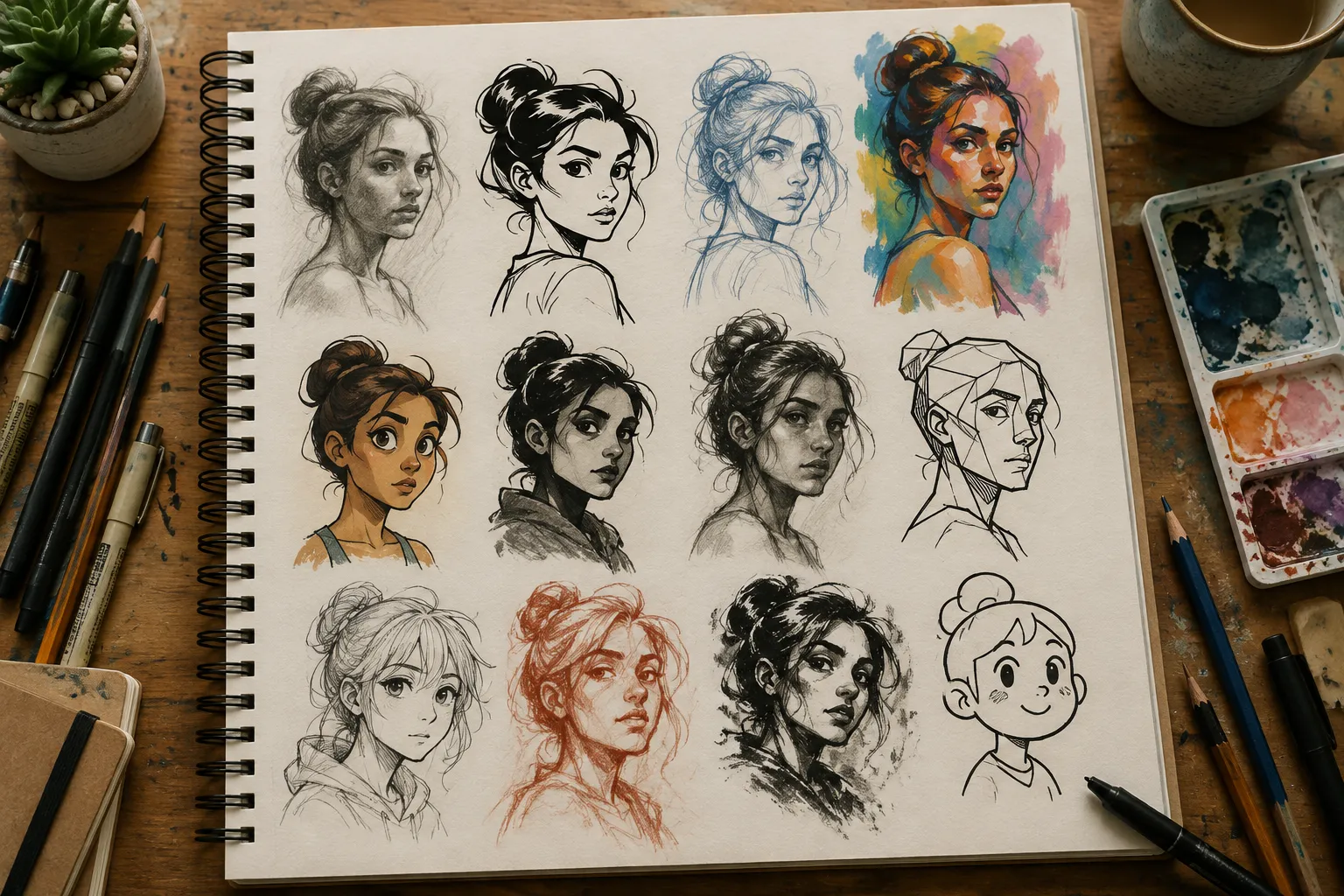
If you're trying to figure out how to find your art style, don't wait for a unique style to suddenly appear. A personal art style usually develops through experimentation, repetition, studying your influences, and recognizing the visual decisions you naturally make again and again.
The exercises below give you a practical way to discover those patterns instead of simply hoping your style develops on its own.
What Is an Art Style?
An art style is the recognizable combination of visual choices that gives an artist's work its character.
Advertisement
Those choices can include:
- Line quality
- Color
- Shape
- Proportions
- Texture
- Brushwork
- Subject matter
- Composition
- Lighting
- Level of realism
- Materials
- Mood
Style isn't necessarily one technique.
Two artists can draw exactly the same subject using the same materials and still produce completely different images because they make different decisions about what to emphasize, simplify, exaggerate, or leave out.
According to Creative Bloq's discussion with professional artists, style isn't only about how you draw—it can also be influenced by what you repeatedly choose to draw.
Read Creative Bloq's discussion of developing an art style
How Do You Find Your Art Style?
The best way to find your art style is to create a large amount of work while deliberately experimenting with color, line, subject matter, materials, composition, and technique.
Then look backward.
Which choices keep appearing?
Which pieces were the most enjoyable to create?
Which techniques do you keep returning to without consciously trying?
Those recurring decisions are clues to your developing artistic voice.
Here are 10 exercises that can help you identify them.
Exercise 1: Build an Influence Map
Choose five to ten artists whose work you genuinely love.
Instead of simply saving their artwork, write down exactly what attracts you to each artist.
For example:
| Influence | What You Like |
|---|---|
| Artist A | Limited colors and dramatic lighting |
| Artist B | Exaggerated anatomy |
| Artist C | Loose brushwork |
| Artist D | Strange characters and surreal subjects |
| Artist E | Simple backgrounds and strong silhouettes |
Now look for patterns.
Maybe most of your favorite artists use muted colors. Perhaps you're consistently attracted to exaggerated characters, unusual anatomy, heavy outlines, or visible brush marks.
Those patterns tell you something about your own visual preferences.
Should You Copy Other Artists to Find Your Style?
Study their decisions, not their identity.
Instead of thinking:
"I want my artwork to look exactly like this artist."
Ask:
"What specific choices make me respond to this artwork?"
Then experiment with those principles using your own subjects and ideas.
Studying several different influences is especially useful because it encourages you to combine ideas rather than imitate a single artist.
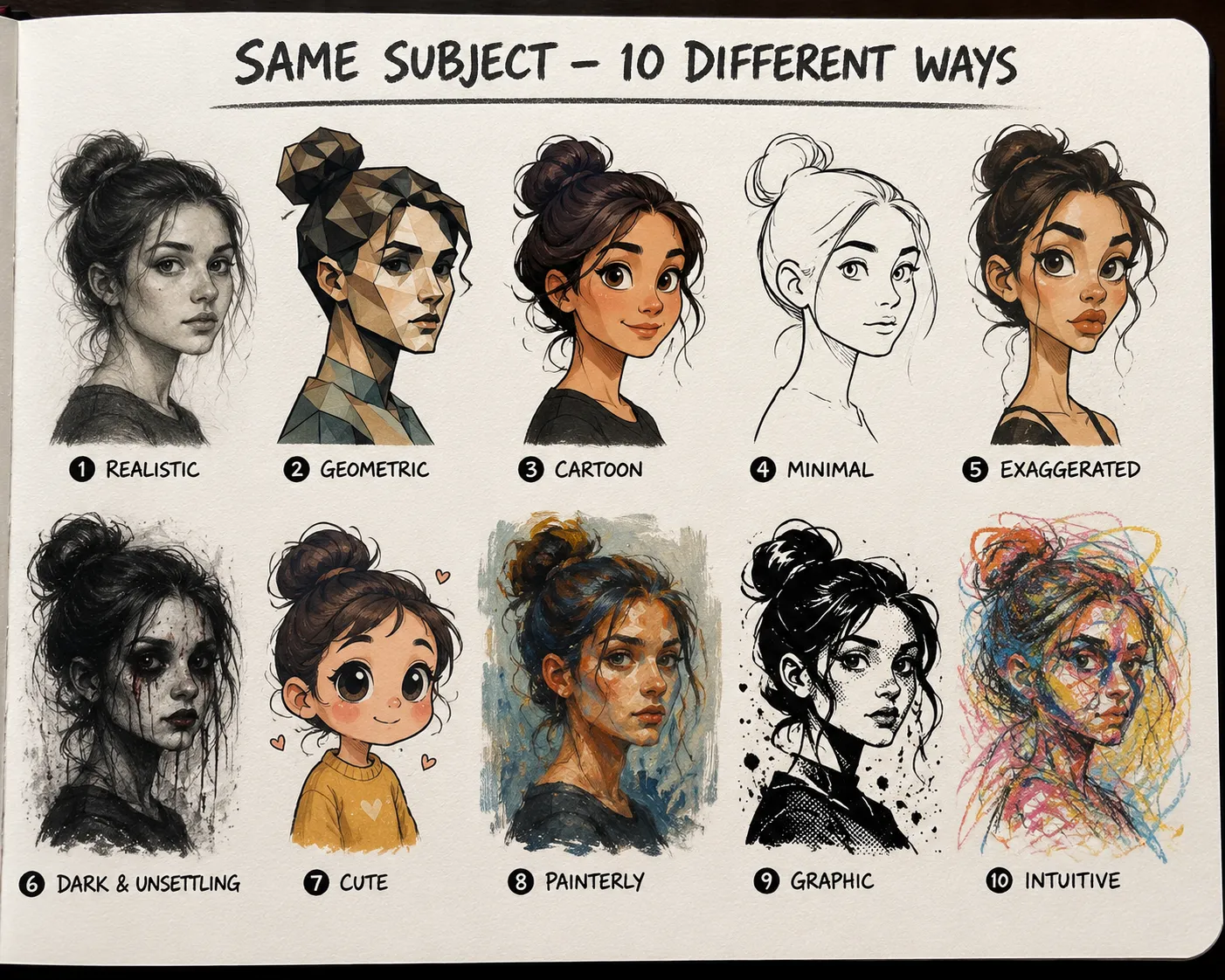
Exercise 2: Draw the Same Subject 10 Different Ways
Choose one simple subject.
It could be:
- A face
- A skull
- A flower
- A house
- A cat
- A hand
- A character
Now draw it 10 times.
Make every version noticeably different.
Try:
- Realistic
- Geometric
- Cartoon
- Minimal
- Exaggerated
- Dark and unsettling
- Cute
- Painterly
- Graphic
- Completely intuitive
Don't judge the drawings while you're creating them.
When you're finished, put all 10 next to one another.
Ask yourself:
Which version was the most enjoyable to make?
Which one would I most want to turn into a finished artwork?
Which version felt the most natural?
Your answers can reveal the visual decisions you actually enjoy making.
Exercise 3: Create Your Own Color Palette
Color can become one of the most recognizable elements of an artist's work.
Choose five colors you instinctively enjoy using.
Then create an illustration using only those colors plus black and white.
Repeat the exercise with several different subjects while keeping the palette consistent.
You may discover that you're naturally attracted to:
- Warm earth tones
- Pastels
- Neon colors
- Muted colors
- High contrast
- Monochromatic artwork
- Unusual color combinations
Save your favorite combinations.
Over time, recurring palettes can become part of your visual identity.
Exercise 4: Fill a Page With Lines
Take a blank sketchbook page and fill it with different kinds of marks.
Try:
- Thick lines
- Thin lines
- Scratchy lines
- Smooth lines
- Broken lines
- Angular lines
- Curved lines
- Heavy outlines
- Almost invisible outlines
- Crosshatching
- Scribbles
- Repeated marks
Don't try to make a finished drawing.
You're investigating how you enjoy making marks.
When the page is full, circle five types of marks you particularly enjoyed creating.
Then make a drawing using primarily those marks.
Line quality is easy to overlook, but it can dramatically change the personality of an illustration.
Recommended Sketchbook for These Exercises
A dedicated sketchbook makes it easier to keep your experiments together and compare how your work changes over time.
The Strathmore 400 Series Sketch Pad is a useful choice for drawing exercises, thumbnails, line experiments, and visual studies.
As an Amazon Associate, The Artillerist may earn from qualifying purchases.
Exercise 5: Combine Three Different Influences
Choose three different artistic influences.
For example:
Influence A: Character proportions Influence B: Color palette Influence C: Texture
Now make an original image combining those qualities rather than copying a particular artwork.
The goal is synthesis.
Personal style rarely develops from a single source. Artists accumulate visual influences from art, illustration, movies, photography, fashion, architecture, games, comics, nature, and everyday life.
Your particular combination of influences can become far more interesting than any single influence on its own.
Exercise 6: Change Your Medium
If you primarily create digital art, spend an afternoon drawing traditionally.
If you normally paint, try ink.
If you usually work with pencils, experiment with collage.
Try:
- Charcoal
- Ink
- Watercolor
- Acrylic
- Colored pencil
- Collage
- Digital painting
- Vector illustration
- Oil pastel
- Marker
Changing mediums removes some of your normal habits.
A digital artist might discover that they love the imperfect edges created by charcoal and later recreate that feeling digitally.
A traditional artist might discover that digital layers encourage an entirely different approach to composition.
If you're interested in experimenting digitally, read How to Start Digital Art: A Complete Beginner's Guide.
Exercise 7: Give Yourself a Creative Limitation
Constraints can force you to make creative decisions you wouldn't normally make.
Give yourself one unusual rule.
For example:
Only use three colors.
Or:
Don't use straight lines.
Or:
Every character must have exaggerated hands.
Other limitations could include:
- Use only one brush
- Finish within one hour
- Don't use outlines
- Use only geometric shapes
- Work entirely in black and white
- Exaggerate proportions
- Use one canvas size
- Don't use the undo button
- Use one digital layer
Create three pieces under the same limitation.
Then ask:
Did the restriction produce something I want to keep?
Sometimes an arbitrary limitation reveals a characteristic that becomes part of your style.
Exercise 8: Redraw an Old Artwork
Find something you created at least a year ago.
Instead of tracing or copying it, recreate the original idea using your current abilities.
Then compare the two versions.
Look for differences:
- Did your proportions change?
- Are your colors different?
- Did your compositions become simpler?
- Are your lines looser?
- Do you exaggerate things differently?
- Has your subject matter changed?
- Has your use of light changed?
These differences are valuable because you didn't necessarily force them.
They provide evidence of how your artistic instincts have already evolved.
If figure drawing is one of the areas you're developing, our Human Anatomy for Artists guide can help strengthen the fundamentals behind stylized figures.
Exercise 9: Create a Three-Piece Series
One isolated artwork doesn't tell you very much about consistency.
A series does.
Choose one theme and create three related pieces.
For example:
Theme: Strange Forest Creatures
Create:
- Forest Creature I
- Forest Creature II
- Forest Creature III
Keep several elements consistent:
- Canvas dimensions
- Palette
- Medium
- Lighting
- Line quality
- Subject treatment
But allow yourself to experiment within those boundaries.
When the three pieces are displayed together, ask:
What makes these look like they were created by the same artist?
The answer can identify some of the strongest characteristics of your developing style.
Exercise 10: Audit Your Last 20 Artworks
This may be the most revealing exercise in the entire guide.
Collect your last 20 finished or nearly finished artworks.
Put them into one folder, print them, lay them on the floor, or create a digital contact sheet.
Now stop looking at them as individual pieces.
Look for patterns.
What Subjects Do You Keep Drawing?
Characters?
Portraits?
Landscapes?
Strange creatures?
Architecture?
Faces?
Nature?
The subjects you repeatedly choose can be as important to your style as the way you render them.
What Colors Keep Appearing?
Look for colors and combinations you repeatedly use.
You may already have a preferred palette without realizing it.
What Shapes Do You Prefer?
Do you naturally use:
- Sharp angles?
- Soft curves?
- Geometric forms?
- Exaggerated proportions?
- Long shapes?
- Compact shapes?
What Techniques Keep Appearing?
Is your work generally:
- Clean
- Messy
- Painterly
- Graphic
- Detailed
- Minimal
- Textured
What Mood Does Your Artwork Have?
Does your work tend to feel:
- Playful
- Melancholic
- Eerie
- Peaceful
- Chaotic
- Nostalgic
- Humorous
- Dreamlike
Write down the characteristics that appear repeatedly.
You may discover that your art style is already much more developed than you thought.
Can You Have More Than One Art Style?
Yes. An artist can have more than one art style.
A recognizable style doesn't require every piece of artwork to look identical.
An illustrator might create highly rendered commercial work while maintaining a loose personal sketchbook practice. A painter could produce colorful figurative work alongside monochromatic drawings.
Your style can also evolve throughout your career.
The goal isn't to trap yourself inside a visual formula. A useful style gives your work identity while leaving room for experimentation.
Should Beginners Worry About Finding an Art Style?
Beginners should experiment with style without sacrificing artistic fundamentals.
Learn:
- Anatomy
- Perspective
- Composition
- Color
- Value
- Shape
- Gesture
- Light
- Form
Improving these skills gives you more control over the rules you eventually choose to follow, exaggerate, simplify, or break.
For artists interested in character and figure work, see Human Anatomy for Artists.
How Long Does It Take to Find Your Art Style?
There is no universal amount of time required to develop an art style.
Instead of asking:
"How long will it take?"
ask:
"Am I beginning to recognize the artistic choices I repeatedly enjoy making?"
If the answer is yes, your style is already developing.
Style can continue changing throughout an artist's career as skills, interests, tools, influences, and experiences change.
Why Does My Art Style Keep Changing?
Your art style may change because you're learning and experimenting.
That's usually not a problem.
Your technical ability improves. You encounter new artists. You try new mediums. Your interests change. You experience different things.
Naturally, your artwork changes too.
Trying to preserve an old style simply because people recognize it can eventually become a creative limitation.
Consistency can be valuable, particularly for professional artists and illustrators, but consistency doesn't require stagnation.
What If My Art Looks Too Much Like Another Artist's Work?
Broaden your influences.
Instead of studying one artist, study:
- Fine art
- Illustration
- Photography
- Film
- Sculpture
- Graphic design
- Fashion
- Architecture
- Comics
- Animation
- Nature
Then identify individual characteristics you admire rather than reproducing complete artworks.
For example, you might study one artist's color, another artist's composition, a photographer's lighting, and an animator's character shapes.
The combination becomes much more personal.
Does Social Media Affect Your Art Style?
It can.
Social media exposes artists to an enormous amount of visual information, which can provide inspiration and introduce you to artists you might never otherwise discover.
But there's another side.
If every creative decision becomes:
"Will this get likes?"
it becomes harder to determine:
"Do I actually like making this?"
Give yourself room to make artwork privately.
Not every experiment needs to become content.
If you're deciding how much social media should factor into your creative career, read Is Instagram Still Worth It for Artists in 2026?.
What Do Other Artists Say About Developing a Style?
There isn't one universally accepted method.
Creative Bloq's interviews with artists emphasize following your instincts, studying what attracts you to other artwork, and examining what you naturally draw when nobody is directing you.
Other artists describe style as something that develops through experimentation and experience rather than something you simply choose.
That's why the exercises in this guide focus on generating evidence.
Instead of deciding what your style should be, you're looking at your own work to discover what characteristics are already emerging.
Watch: How to Find Your Art Style
Contemporary Art Issue offers another useful perspective in How To Find Your Art Style (Using this 1 Exercise & 6 Possible Strategies).
The video discusses common mistakes, strategies for developing consistency, real artist examples, and a practical exercise for identifying your style.
Conclusion: How to Find Your Art Style
The most practical answer to how to find your art style is surprisingly simple: make work, experiment deliberately, and then study the evidence.
Don't wait until you've invented the perfect artistic identity before creating.
Draw the same subject 10 ways.
Limit your palette.
Experiment with your linework.
Change mediums.
Study several influences.
Redraw old artwork.
Create a series.
Then put your work together and look for the decisions that keep appearing.
Try These 10 Art Style Exercises
- Build an influence map.
- Draw the same subject 10 different ways.
- Create your own color palette.
- Fill a page with different lines.
- Combine three influences.
- Change your medium.
- Give yourself a creative limitation.
- Redraw an old artwork.
- Create a three-piece series.
- Audit your last 20 artworks.
Start with Exercise #2 today: choose one simple subject and draw it 10 different ways.
Your goal isn't to make 10 masterpieces.
Your goal is to discover which version makes you want to create number 11.
Frequently Asked Questions
How do I find my art style as a beginner?
To find your art style as a beginner, experiment with different subjects, mediums, colors, linework, and techniques while continuing to learn artistic fundamentals. Review your work regularly and identify the visual choices you repeatedly enjoy making.
What is the fastest way to find your art style?
There isn't an instant method, but you can accelerate the process through deliberate experimentation. Drawing the same subject in multiple styles, studying several artistic influences, creating small series, and reviewing your previous work can reveal recurring preferences.
Can I have more than one art style?
Yes. Artists can use multiple styles for different mediums, subjects, clients, or bodies of work. Your artistic identity does not require every piece you create to look identical.
Is it okay to study another artist's style?
Studying other artists can teach you about composition, color, line, shape, and technique. Study multiple influences and apply what you learn to your own subjects rather than presenting another artist's work or distinctive expression as your own.
How can I make my art style more consistent?
Create a small series using recurring decisions such as the same color palette, medium, line treatment, proportions, or subject matter. Compare the pieces afterward and identify which characteristics you want to continue.
Should I find my art style before building a portfolio?
No. Developing a portfolio and developing an art style can happen simultaneously. In fact, creating more work gives you more evidence for identifying the characteristics that make your artwork recognizable.
Why can't I find my art style?
You may simply need more experimentation and finished work to compare. Instead of trying to decide what your style should look like, create variations and examine the subjects, colors, shapes, techniques, and moods you repeatedly choose.
Does every artist need a unique art style?
No. A recognizable style can help establish an artistic identity, but creating compelling and meaningful artwork is more important than forcing every piece into a predetermined visual formula.
Can my art style change over time?
Yes. Art styles commonly evolve as artists improve their skills, encounter new influences, experiment with different materials, and develop new interests.
How do I know when I've found my art style?
Look across a body of your work rather than one image. If you can identify recurring choices in line, color, shape, composition, subject matter, texture, or mood, those patterns are evidence that a recognizable style is developing.