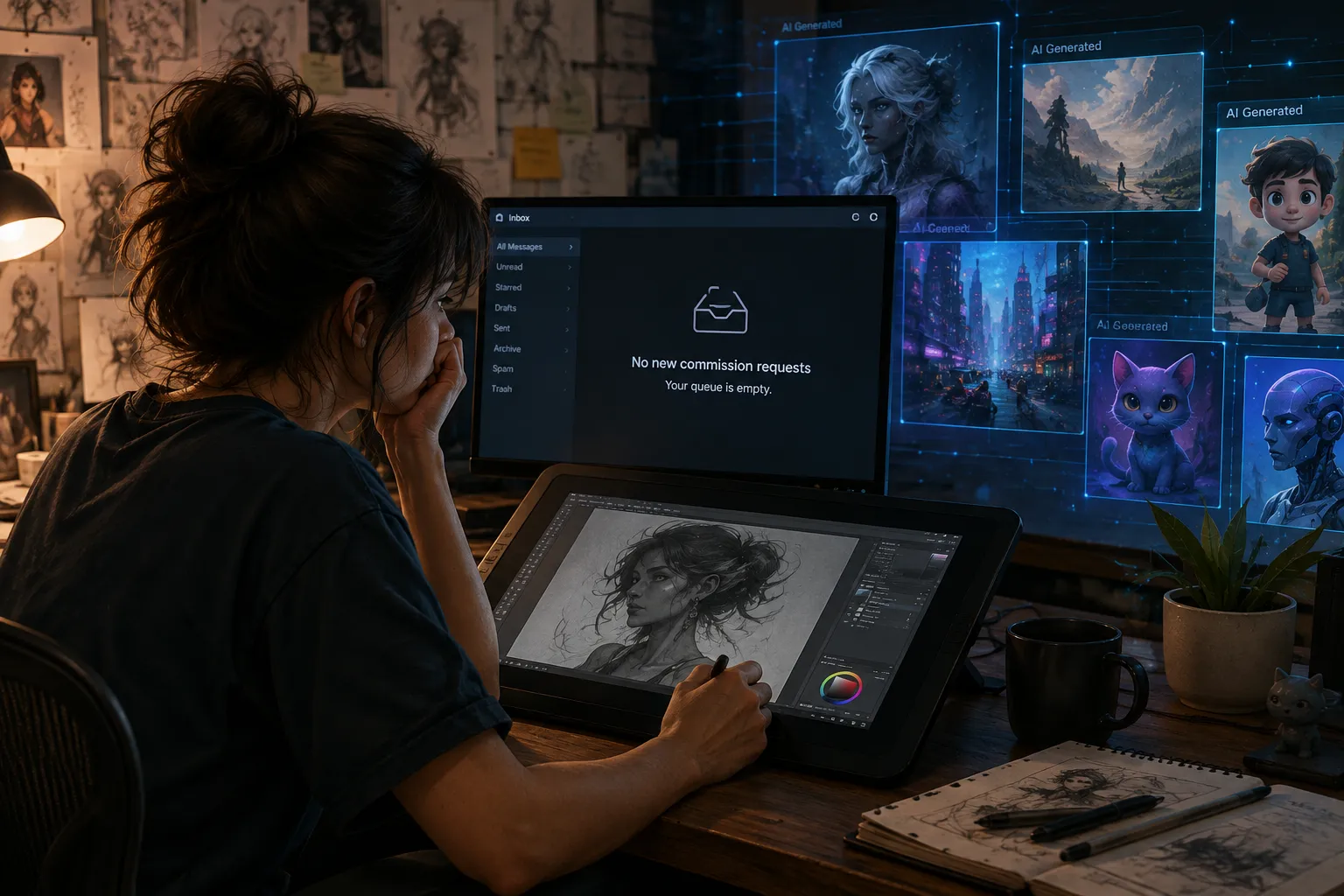
If you're an artist who feels like commissions have suddenly become harder to find, you're not imagining the conversation.
Across online artist communities, illustrators and freelancers are asking versions of the same question:
Where did all the art commissions go?
Advertisement
Artists describe going from regular commission work to struggling to find clients. Others say their commission posts still receive likes and bookmarks, yet only a handful of paying customers actually appear.
The obvious explanation is artificial intelligence.
But the real answer is more complicated.
Generative AI is changing the commission market, but it's colliding with several other trends at the same time: more competition, changing social media algorithms, tighter client budgets, faster expectations, and a growing disconnect between having an audience and having customers.
The commission economy isn't necessarily disappearing.
It's changing.
Are Artists Really Getting Fewer Commissions?
There isn't a single database tracking every private art commission, so claims that the entire commission market has collapsed should be treated cautiously.
There is, however, growing evidence that parts of the creative economy are being disrupted.
The Incorporated Society of Musicians' Brave New World? report found that 32% of illustrators surveyed reported losing commissions or having projects canceled because of generative AI.
The impact may be particularly significant for smaller creative assignments.
Adobe Research studied 1,433 working creatives as part of a larger examination of how AI is affecting creative work. Its research suggests something more complicated than the complete replacement of creative professionals.
Instead, Adobe describes what is happening as a redistribution of creative work.
The company found evidence that clients are increasingly accepting AI-generated material for some lower-stakes deliverables. Creative professionals specifically reported doing fewer social media deliverables because some clients were generating that material themselves.
At the same time, Adobe found continued demand for higher-stakes creative work requiring human judgment, taste, accountability, collaboration, and verifiable provenance.
That distinction matters.
The market isn't simply moving from:
Human artist → AI
It's becoming fragmented.
Some work is disappearing.
Some work is changing.
And some creative work remains difficult to replace.
AI Is Taking Some of the Small Jobs
Consider the kinds of commissions people traditionally hired artists to create:
- Profile pictures
- Character portraits
- Social media graphics
- Simple logos
- Album artwork
- Posters
- Avatars
- Concept sketches
- Personalized gifts
These were often relatively inexpensive commissions.
They were also important.
A $75 character portrait might not sound significant by itself, but several small commissions every month could provide an artist with meaningful income between larger projects.
Generative AI has dramatically lowered the barrier for someone who simply wants an image.
A customer who once had two options—
make it themselves or hire an artist
—now has a third:
Generate it.
That doesn't mean AI has eliminated professional illustration.
It means some of the easiest creative work to automate overlaps with the work many emerging artists have historically depended upon.
The ISM report on generative AI and creators provides one of the clearest examples: nearly one-third of illustrators surveyed reported losing commissions or canceled projects because of generative AI.
But AI Isn't the Whole Story
Blaming every disappearing commission on AI would be too simple.
Other research paints a much more complicated picture.
Adobe's 2026 research found that U.S. creative professional job postings increased 8% between September 2025 and April 2026, rising from roughly 10,500 to 11,300 postings.
At the same time, the percentage of creative job postings explicitly requesting AI skills increased from 10% to 15%.
You can read the full findings in Adobe's report on how AI is redistributing creative work.
So how can artists report losing commissions while demand for creative professionals still exists?
Because creative employment and independent art commissions aren't necessarily the same market.
A company hiring an experienced creative director isn't equivalent to someone paying $80 for a custom portrait.
AI may therefore be changing which creative services people are willing to pay for rather than eliminating the need for creative professionals altogether.
Social Media Attention Doesn't Equal Customers
Another problem has little to do with artistic ability.
Artists have spent more than a decade being encouraged to build audiences on Instagram, TikTok, X, Reddit, and other platforms.
That created an assumption:
More followers = more customers.
Unfortunately, it doesn't always work that way.
An artist can have:
10,000 followers.
1,000 likes.
100 comments.
And zero commissions.
The distinction is important:
An audience consumes. A customer buys.
Artists who depend entirely on social media algorithms are essentially renting access to their audience.
An algorithm change can dramatically reduce that access overnight.
That's one reason artists should consider building platforms they control—including a portfolio website, mailing list, customer database, or online shop.
For artists evaluating marketplaces as another sales channel, read our comparison of Etsy, Redbubble, and Society6 to understand how the major platforms differ.
Competition Has Exploded
AI isn't the only new competitor.
Artists are competing with more artists, too.
The internet created a global commission marketplace.
A buyer in Las Vegas can commission an illustrator in London, Manila, Tokyo, Mexico City, or São Paulo almost as easily as someone down the street.
That's incredible for artists.
It's also brutal.
Artists are competing across radically different costs of living, experience levels, styles, audiences, and pricing.
Trying to compete primarily by lowering prices can therefore become a race nobody wins.
The alternative is differentiation.
Your Niche Matters More Than Ever
One of the most interesting things about current artist discussions is that experiences aren't universal.
Some artists report that commissions have almost disappeared.
Others say they're overwhelmed with requests.
That suggests something important:
The commission market hasn't disappeared equally across every artistic niche.
Certain communities remain highly interested in commissioning original artwork.
These can include:
- Furry artwork
- Pet portraits
- Fantasy characters
- Dungeons & Dragons characters
- Tattoo designs
- Horror artwork
- Lowbrow
- Pop surrealism
- Automotive art
- Comic artwork
- Music-related artwork
- Personalized portraits
That doesn't mean struggling artists should simply chase whichever niche happens to be popular.
It demonstrates something more important:
Specific communities still value specific artists.
People don't commission those artists simply because they need an image.
They want that artist's image.
And that distinction may become increasingly valuable in an AI-heavy world.
Your Art Style Is Becoming Part of the Product
Imagine two artists.
Artist A advertises:
"I draw custom portraits."
Artist B creates strange, instantly recognizable surreal portraits with exaggerated eyes, muted colors, and recurring dreamlike imagery—and has spent years building an audience around that aesthetic.
AI puts significantly more pressure on Artist A.
The customer is purchasing an outcome:
I need a portrait.
Artist B is selling something different:
I want a piece created by this artist.
The artist becomes part of the value proposition.
Developing that identity doesn't happen overnight. If you're still figuring out what separates your work from everyone else's, read The Artillerist's guide on how to find your art style.
A recognizable artistic voice isn't merely an aesthetic advantage anymore.
It can be a business advantage.
Human-Made May Become a Selling Point
There's another unexpected consequence of AI.
The process of creating art may become part of the product.
For decades, digital artists generally showed customers the finished image.
Now customers may increasingly want to know:
Who made this?
How was it created?
Was AI involved?
Is this actually original?
That gives human artists something valuable to show.
Instead of posting only finished pieces, document:
- Sketches
- Thumbnails
- Brush strokes
- Layer progress
- Time-lapses
- Revisions
- Studio photos
- Failed attempts
- Behind-the-scenes videos
You're not merely proving that the artwork is human-made.
You're allowing people to participate in its creation.
The imperfections, decisions, revisions, and experimentation that happen along the way become part of the story.
Adobe's research supports the importance of this distinction. Its researchers found that working creative professionals were often willing to use AI for particular tasks while deliberately keeping it away from parts of the process involving authenticity, artistic integrity, ownership, and emotional impact.
Read more in Adobe Research's study of how creatives are thinking about AI.
Stop Selling "An Image"
This may be the biggest lesson for commission artists.
If your product is simply an image, you're now competing against technology capable of producing thousands of images almost instantly.
That's an uncomfortable competition.
Instead, consider what AI has difficulty providing:
A relationship with an artist.
A commission can become an experience.
Imagine someone commissioning a portrait and receiving:
- A consultation with the artist
- Initial sketches
- Progress updates
- A finished high-resolution piece
- A signed physical print
- A short time-lapse showing its creation
- A certificate identifying the work and artist
Now the customer isn't buying a JPEG.
They're commissioning an artwork from a person.
That difference matters.
Build Around Communities, Not Algorithms
Broad audiences aren't always the most valuable audiences.
A smaller community of people obsessed with the subject you create may be worth considerably more than thousands of casual followers.
That could mean:
- Horror art
- Lowbrow
- Pop surrealism
- Pet portraits
- Tattoo-inspired illustration
- Fantasy characters
- Furry art
- Dungeons & Dragons characters
- Automotive art
- Music culture
- Comic art
- Dark fantasy
- Local landmarks
The narrower the community, the easier it becomes for people to understand what makes you different.
Instead of saying:
"I make art."
You can become:
"The artist who makes those bizarre retro monster portraits."
That is memorable.
Give People an Obvious Way to Commission You
Sometimes the problem isn't demand.
It's friction.
A potential customer shouldn't have to DM you just to discover:
- Whether commissions are open
- What they cost
- What you will draw
- How long they take
- What they'll receive
- How revisions work
- How to pay
Create a dedicated commission page.
Show examples and starting prices.
Explain your process.
Answer common questions.
Include a clear Commission Me button.
If someone becomes excited about your work at 11:30 p.m., they should be able to understand how to hire you without waiting for a DM response the next morning.
Don't Depend on One Income Stream
The commission slowdown also highlights a larger problem with freelance art:
One revenue stream is fragile.
A healthier creative business might combine several:
Commissions + originals + prints + digital products + licensing + memberships + merchandise + teaching + affiliate income
Not every artist needs all of them.
The point is diversification.
If commissions decline temporarily, your entire creative business shouldn't disappear with them.
So, Where Did All the Art Commissions Go?
The answer isn't as simple as saying AI killed art commissions.
Some commissions have likely gone to AI.
Some smaller creative jobs are being handled directly by clients.
Some are being fought over by a larger global pool of artists.
Some may be affected by changing consumer spending.
And some never disappeared at all—they remain concentrated in specialized communities where buyers strongly value individual creators.
The research supports this more nuanced picture.
The Incorporated Society of Musicians found substantial commission losses among surveyed illustrators.
At the same time, Adobe Research found creative hiring increasing and describes the broader change as a redistribution of creative work rather than straightforward replacement.
The work that remains valuable increasingly involves things AI has difficulty providing on its own:
Judgment.
Originality.
Reliability.
Collaboration.
Taste.
Trust.
Authenticity.
A human point of view.
That's the opportunity.
AI can generate another image.
It cannot build your reputation for you.
It cannot develop genuine relationships with your collectors.
It cannot attend conventions as you.
It cannot give someone an original sketch made by your hand.
And it cannot make someone care that you created the work.
The artists who thrive in the next version of the commission economy may therefore be the ones who stop trying to compete with machines at producing images faster and instead become increasingly difficult to substitute.
Don't just give people a reason to buy art.
Give them a reason to buy yours.