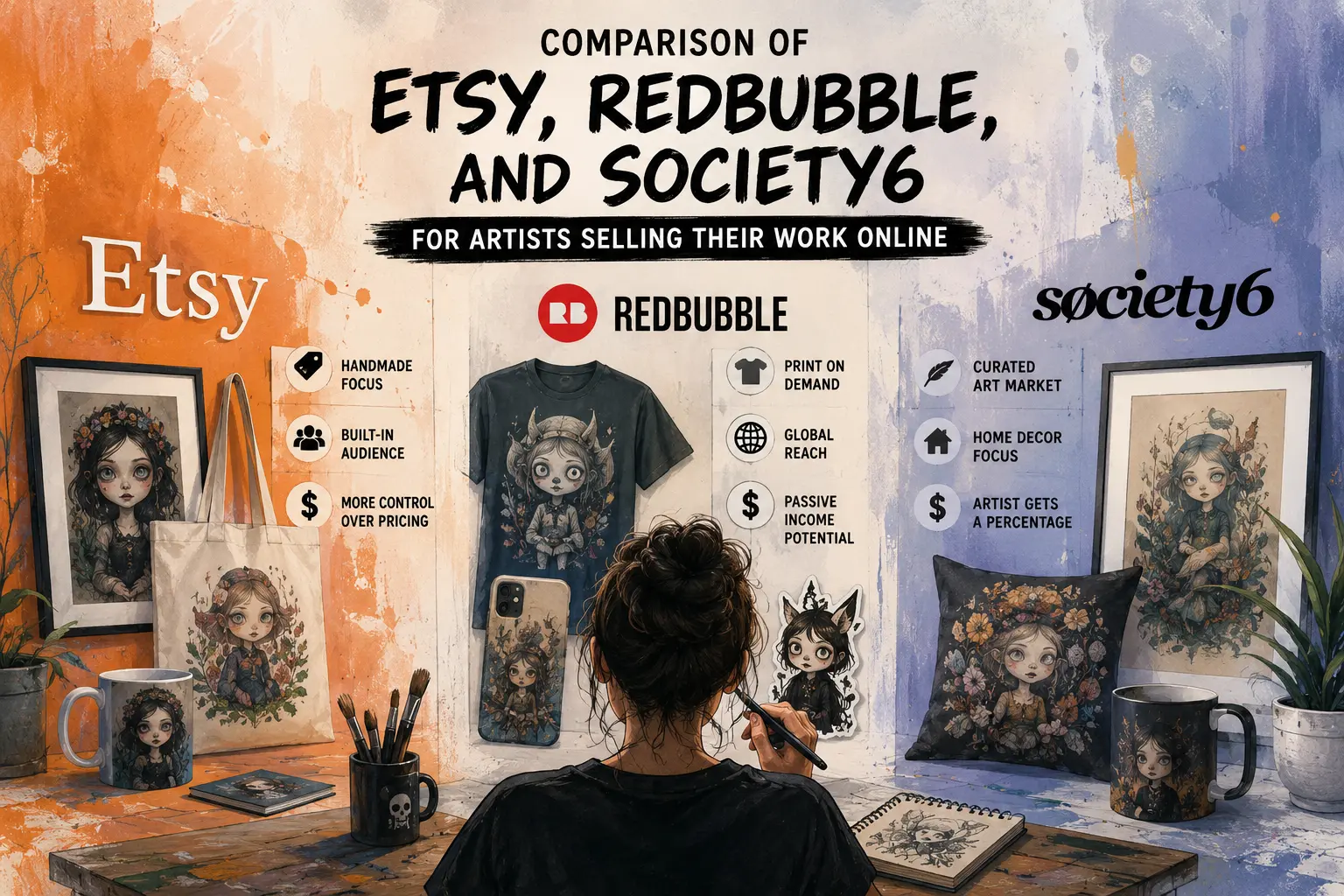
Etsy vs Redbubble vs Society6 comes down to one question: do you want to run a shop, or do you want to upload art and let someone else handle the rest? Etsy puts you in charge of production, pricing, and customer service in exchange for keeping more of each sale. Redbubble and Society6 are print-on-demand marketplaces — they print, ship, and handle returns, but they take a bigger cut and give you less control over presentation.
Here's how the three actually compare, what each one costs, and which one fits different kinds of artists.
What Makes These Platforms Different
Etsy is a marketplace for handmade, vintage, and digital goods. Unless you connect a print-on-demand tool like Printful, you're responsible for making or sourcing your products, packing orders, and handling shipping yourself. You set your own prices and keep the majority of each sale after fees.
Advertisement
Redbubble and Society6 are both print-on-demand (POD) marketplaces built specifically for artists. You upload a design once, and it gets printed on everything from t-shirts to phone cases to throw pillows whenever someone buys. Neither platform requires inventory, packing, or shipping on your end — but you earn a smaller percentage per sale in exchange for that convenience.
Etsy for Artists
Etsy works best for artists selling original paintings, prints they package and ship themselves, or digital downloads like planners and printable art.
Fees:
- $0.20 listing fee per item (renews every 4 months or when it sells)
- 6.5% transaction fee on the total sale, including shipping
- Payment processing fee of roughly 3% + $0.25 for US sellers
- An optional 12–15% Offsite Ads fee, which becomes mandatory once you pass $10,000 in annual sales — though it only applies to sales that come directly from one of those ads
Altogether, most sellers land around 10–15% in combined fees before advertising, though it can climb past 20% for sellers who owe the Offsite Ads fee.
Good for: artists who want full control over pricing, packaging, and branding, and who don't mind handling their own fulfillment (or pairing Etsy with a POD integration).
Trade-off: more manual work, and fees can eat into thin margins on lower-priced items if you're not pricing carefully.
Redbubble for Artists
Redbubble is a print-on-demand marketplace with one of the largest product catalogs in the space — 70+ product types, from stickers and t-shirts to notebooks and duvet covers.
How you get paid: Redbubble sets a base price for each product, and you add a markup on top, called your "artist margin." The default is 20%, and most sellers keep it somewhere between 15–30%. You earn that margin on every sale; Redbubble keeps the base price to cover printing, shipping, and running the platform.
Typical earnings: roughly $2–$5 per t-shirt, $0.30–$0.60 per sticker, and more on higher-priced items like canvas prints.
Good for: bold, graphic, pop-culture-adjacent art — the kind of design that reads well on a t-shirt or sticker at a glance. Stickers in particular are a strong earner on Redbubble because they're cheap, impulse-buy items.
Trade-off: you're competing inside a huge marketplace where buyers browse Redbubble's own search rather than looking for you specifically, so building recognition as an artist is harder here than on your own shop.
Society6 for Artists
Society6 leans toward fine art, photography, and home decor — its catalog of roughly 50 product types is noticeably stronger in wall art, furniture, and textiles than Redbubble's.
How you get paid: Society6 uses a flat 10% royalty on most products by default (you can adjust it), with one notable exception — for art prints, you set your own retail price directly. On a $35 product at the standard 10% rate, for example, you'd earn about $3.50.
Typical earnings: most artists report modest income, often in the $50–$200/month range, unless they're driving their own traffic from Instagram, a newsletter, or another following. Society6's own marketplace traffic alone rarely produces significant income on its own.
Good for: artists whose work suits large-format prints, home decor, and a more curated, design-forward aesthetic.
Trade-off: the lowest per-sale earnings of the three on most products, and like Redbubble, you're building Society6's brand more than your own.
Etsy vs Redbubble vs Society6: Side-by-Side
| Etsy | Redbubble | Society6 | |
|---|---|---|---|
| Model | You fulfill (or connect a POD tool) | Print-on-demand | Print-on-demand |
| Cost to join | Free (pay per listing/sale) | Free | Free |
| You earn | ~85–90% of sale price minus fees | Your set margin (avg. ~20%) | Flat 10% royalty (adjustable) |
| Typical fee load | ~10–15%, 20%+ with ads | Redbubble keeps the base price | Society6 keeps ~90% of base |
| Best for | Original art, self-shipped prints, digital downloads | Bold, graphic designs on everyday products | Fine art, photography, home decor |
| Who ships it | You (unless using a POD integration) | Redbubble | Society6 |
Which Platform Should You Actually Choose?
- Want maximum control and are willing to do the work? Start with Etsy. You'll earn more per sale and build a shop that's recognizably yours.
- Want to test a lot of designs with zero risk and no fulfillment? Redbubble's huge catalog and self-set margin make it the easiest starting point.
- Making fine art, photography, or home-decor-friendly work? Society6's audience and product range are the better match, even with the lower default royalty.
- Not sure yet? Nothing stops you from listing the same design on all three. Most successful print-on-demand artists do exactly that, since cross-listing costs nothing extra and multiplies your chances of a sale.
Whichever platform you pick, your price still needs to cover your time and materials, not just match whatever the platform defaults to. Our guide on how to price your artwork walks through exactly how to calculate a number that actually makes sense once fees are factored in.
Frequently Asked Questions
Can I sell on Etsy, Redbubble, and Society6 at the same time? Yes. None of the three require exclusivity, and cross-listing the same artwork is common practice since it costs nothing extra and increases your total exposure.
Which platform pays artists the most per sale? It depends on the product, but Redbubble generally pays more per unit than Society6 because you control your own markup, while Etsy usually nets the highest percentage overall since there's no print manufacturer built into the base price.
Do I need a business license to sell on these platforms? Requirements vary by country and by how much you earn, so it's worth checking your local regulations directly — this isn't something any of the three platforms can answer for you.
Which platform is easiest for a complete beginner? Redbubble and Society6 are typically the easiest starting points since there's no inventory, shipping, or customer service to manage — you upload art and the platform does the rest.
Bottom Line
There's no single winner here — Etsy, Redbubble, and Society6 solve different problems. Etsy rewards artists willing to run a real shop. Redbubble and Society6 trade a smaller cut for zero fulfillment work, with Redbubble better suited to graphic, everyday-object designs and Society6 better suited to fine art and home decor. Many artists end up using more than one, treating each as a different channel for the same body of work rather than picking just a single platform.