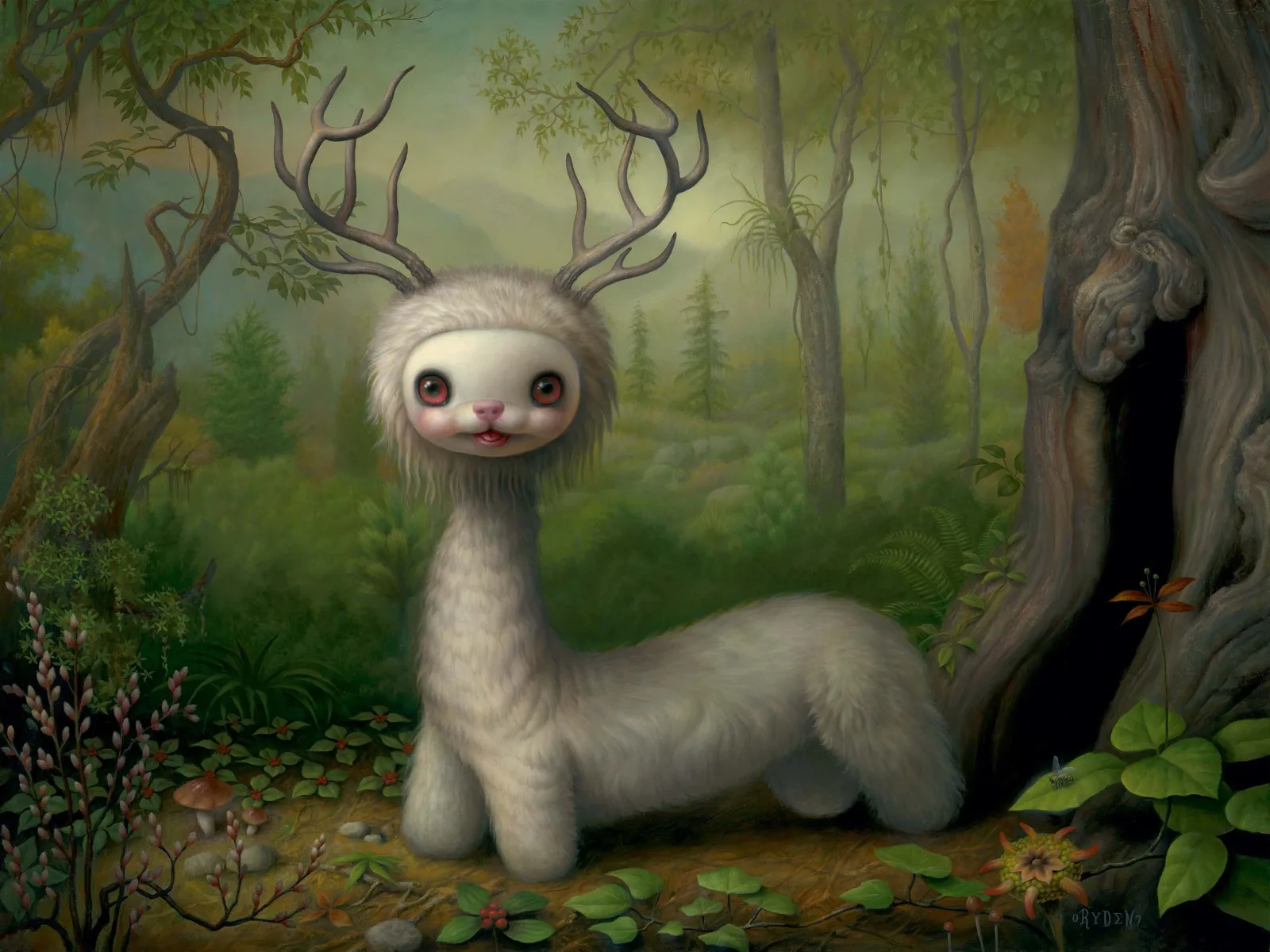
Quick Facts
| Artist | Mark Ryden |
| Nationality | American |
| Born | January 20, 1963 |
| Art Movement | Pop Surrealism (Lowbrow Art) |
| Primary Medium | Oil on canvas and panel |
| Known For | Dreamlike symbolic paintings that combine classical painting techniques with pop culture, mythology, religion, and surreal imagery |
| Education | ArtCenter College of Design, Pasadena, California |
| Based In | California, United States |
| Active Since | Late 1980s |
| Notable Series | The Meat Show, Bunnies & Bees, The Tree Show, The Snow Yak Show, The Gay 90s |
| Influences | Renaissance painting, Victorian illustration, children's books, religion, mythology, science, Americana, carnival culture |
| Recommended For | Artists interested in narrative painting, symbolism, Pop Surrealism, Lowbrow Art, and imaginative realism |
| Official Website | markryden.com |
In Brief: Mark Ryden is widely regarded as one of the defining artists of the Pop Surrealism movement. His meticulously crafted oil paintings combine classical realism with symbolic imagery, creating dreamlike narratives that have influenced generations of contemporary painters and illustrators.
Mark Ryden: The Visionary Who Helped Define Pop Surrealism
If you've ever wandered into an art gallery and felt as though you had stepped into a beautifully painted dream—or perhaps a strange fairy tale that felt both comforting and unsettling—there's a good chance you've encountered the work of Mark Ryden.
Often referred to as one of the pioneers of Pop Surrealism, Ryden has spent decades creating paintings that blur the boundaries between innocence and darkness, beauty and mystery, fantasy and reality.
Advertisement
His work is immediately recognizable. Large-eyed children, antique toys, raw meat, religious symbolism, Victorian imagery, scientific diagrams, and impossible dreamlike landscapes frequently coexist inside a single composition.
For artists, Ryden's paintings are much more than visually striking—they're masterclasses in storytelling, symbolism, composition, and technical craftsmanship.
Short Answer
Mark Ryden is an American painter widely associated with Pop Surrealism (Lowbrow Art). His paintings combine classical oil painting techniques with surreal imagery, childhood nostalgia, symbolism, religion, science, mythology, and fantasy to create emotionally complex narratives.
Table of Contents
- Who Is Mark Ryden?
- What Is Pop Surrealism?
- Mark Ryden's Signature Style
- Themes Found Throughout His Work
- What Artists Can Learn
- Recommended Books
- Frequently Asked Questions
Who Is Mark Ryden?
Mark Ryden emerged during the 1990s as one of the defining voices of the Pop Surrealism movement.
While many contemporary artists embraced conceptual art or abstraction, Ryden focused on carefully rendered oil paintings inspired by Renaissance masters, nineteenth-century illustration, children's books, carnival culture, Victorian aesthetics, and American pop culture.
Rather than choosing between fine art and popular imagery, he merged both worlds into something entirely new.
Today his paintings have been exhibited internationally and are widely collected by museums and private collectors.
What Is Pop Surrealism?
Pop Surrealism—sometimes called Lowbrow Art—developed largely in Southern California.
Unlike traditional fine art movements, Pop Surrealism freely mixes influences from:
- Comic books
- Advertising
- Cartoons
- Classic illustration
- Tattoo culture
- Toys
- Religious imagery
- Fantasy
- Folk art
Mark Ryden became one of the artists most responsible for bringing this movement into major galleries.
If you're new to the movement, read our guide:
→ The Complete Guide to Lowbrow Art Techniques
What Makes Mark Ryden's Paintings So Unique?
Although every painting is different, several characteristics appear again and again.
Extraordinary Technical Skill
Ryden paints with incredible precision.
His brushwork is smooth.
His lighting feels believable.
His understanding of anatomy allows even fantastical figures to feel convincing.
This technical foundation gives viewers permission to believe the impossible worlds he creates.
Symbolism Everywhere
One of Ryden's greatest strengths is symbolism.
His paintings often include recurring imagery such as:
- Bees
- Meat
- Abraham Lincoln
- Trees
- Saints
- Children
- Rabbits
- Monkeys
- Scientific instruments
- Vintage toys
Rather than explaining every symbol, Ryden allows viewers to develop their own interpretations.
That mystery is part of the experience.
Beautiful Contradictions
His paintings often feel peaceful...
...until you notice something unsettling.
Cute children stand beside raw meat.
Angelic faces appear beneath ominous skies.
Religious imagery sits alongside carnival attractions.
These contrasts create emotional tension that keeps viewers looking longer.
Color Palette
Ryden frequently works with:
- Creams
- Warm browns
- Soft pinks
- Ivory
- Muted reds
- Antique golds
- Earth tones
These colors reinforce the feeling that his paintings belong to another era while remaining strangely timeless.
Composition
Artists studying Ryden should pay attention to how he organizes visual information.
His paintings rarely feel cluttered despite containing dozens of symbolic objects.
He achieves this through:
- Strong focal points
- Symmetry
- Careful value control
- Deliberate spacing
- Balanced color relationships
Every object appears intentional.
Nothing feels accidental.
What Artists Can Learn
1. Technical skill matters.
Ryden's imagination succeeds because it is supported by excellent draftsmanship.
2. Develop recurring themes.
Rather than inventing entirely new subjects every painting, Ryden revisits ideas repeatedly.
This creates a recognizable artistic identity.
3. Tell stories without words.
Many paintings never explain what's happening.
Instead, viewers construct their own narratives.
That mystery encourages repeated viewing.
4. Build a visual vocabulary.
Notice how certain motifs return throughout his work.
Artists should consider developing recurring symbols of their own.
5. Master the fundamentals first.
Perspective.
Lighting.
Anatomy.
Composition.
These timeless skills allow imagination to flourish.
Recommended Books
If you'd like to explore Ryden's work further, these books are excellent additions to any artist's library.
Mark Ryden: The Tree Show
Affiliate Link
Mark Ryden: Blood
Affiliate Link
Best Sketchbook for Daily Drawing
A strong sketchbook helps artists develop the observational skills that underpin imaginative work.
Recommended: Strathmore 400 Series Sketch Pad
Colored Pencil Recommendation
Many artists enjoy studying Ryden's paintings by creating color studies.
Recommended: Prismacolor Premier Colored Pencils
Similar Artists
If you enjoy Mark Ryden's work, explore:
- Marion Peck
- Todd Schorr
- Camille Rose Garcia
- Greg Simkins
- Travis Louie
- Audrey Kawasaki
- Robert Williams
- Gary Baseman
Final Thoughts
Mark Ryden's influence extends far beyond Pop Surrealism.
He demonstrated that technical excellence and imagination are not opposing forces—they strengthen one another.
His paintings reward patience.
Every viewing reveals another symbol.
Another relationship.
Another question.
For artists, perhaps the greatest lesson Ryden offers is this:
Don't create artwork that explains everything.
Create artwork that invites curiosity.
That sense of mystery is often what keeps viewers returning long after they've left the gallery.
Frequently Asked Questions
Is Mark Ryden considered a Lowbrow artist?
Yes. Mark Ryden is widely regarded as one of the most influential artists associated with the Lowbrow (Pop Surrealism) movement.
What medium does Mark Ryden primarily use?
He is best known for meticulously crafted oil paintings on panel or canvas.
What inspired Mark Ryden?
His work draws from classical painting, children's books, religion, mythology, science, Americana, antique toys, and popular culture.
Why is Mark Ryden so influential?
Ryden helped bring Pop Surrealism into mainstream gallery spaces while demonstrating that imaginative contemporary art could be executed with traditional technical mastery.
What artists are similar to Mark Ryden?
Artists frequently discussed alongside Ryden include Marion Peck, Todd Schorr, Camille Rose Garcia, Greg Simkins, Gary Baseman, Travis Louie, and Audrey Kawasaki.
Notable Works Worth Studying
One of the best ways to understand Mark Ryden's work is to spend time with individual paintings rather than simply scrolling through a gallery of images.
His paintings reveal themselves slowly.
At first, viewers often notice the incredible craftsmanship. On closer inspection, they begin discovering symbols, hidden relationships, recurring characters, and visual metaphors that transform each painting into a puzzle waiting to be explored.
Rather than asking, "What does this painting mean?" it is often more rewarding to ask, "Why did Ryden choose these particular objects?"
That simple shift in perspective changes the viewing experience completely.
The Meat Show
Among Ryden's most discussed bodies of work is The Meat Show.
The paintings juxtapose beautifully rendered children, elegant compositions, and carefully painted cuts of meat.
The imagery has generated countless interpretations.
Some viewers see commentary on consumer culture.
Others interpret the work through religious symbolism.
Still others see reflections on mortality, innocence, sacrifice, or humanity's relationship with nature.
Ryden has generally allowed viewers to develop their own interpretations rather than providing definitive explanations.
What artists can learn
One lesson from this series is that symbolism becomes more powerful when it isn't completely explained.
Instead of telling viewers exactly what to think, Ryden invites them to participate in the storytelling.
The Tree Show
Trees have appeared throughout art history as symbols of knowledge, life, growth, and spiritual connection.
Ryden's exploration of trees transforms these familiar ideas into dreamlike narratives filled with unusual characters and symbolic imagery.
Notice how the trees often become more than background elements.
They act almost like silent characters within the composition.
Artist takeaway
Think about how ordinary objects in your own artwork might become symbolic rather than merely decorative.
The Gay 90s
This series draws inspiration from Victorian imagery and Americana while maintaining Ryden's unmistakable surreal aesthetic.
The paintings combine elegance with absurdity.
Refined clothing, antique toys, decorative patterns, and impossible visual combinations create an atmosphere that feels nostalgic while remaining strangely unsettling.
One reason this work feels so cohesive is Ryden's commitment to a consistent visual language.
Everything belongs in the same fictional universe.
Understanding Ryden's Visual Language
Great artists often develop something beyond a recognizable style.
They develop a recognizable language.
When viewers see one of Ryden's paintings from across a room, they often know immediately who painted it.
That recognition doesn't happen by accident.
It comes from years of refining recurring ideas.
Some elements frequently associated with his work include:
- Large-eyed children
- Rabbits
- Bees
- Antique toys
- Victorian clothing
- Religious imagery
- Scientific references
- Meat
- Decorative frames
- Nature
- Mythological symbolism
Notice that none of these subjects are particularly unusual on their own.
What makes them memorable is the way they repeatedly interact with one another.
Composition Lessons
For artists studying Ryden, composition may be even more valuable than subject matter.
Many paintings demonstrate remarkable visual balance.
Clear focal points
Your eye almost always knows where to begin.
Strong value contrast.
Careful lighting.
Subtle framing.
Everything guides attention naturally.
Controlled complexity
Although Ryden's paintings contain many details, they rarely feel chaotic.
This is because detail is distributed intentionally.
Areas of complexity are balanced with quieter areas that allow the eye to rest.
This principle applies to every style of art.
More detail does not necessarily make a painting stronger.
Better organization does.
Symmetry
Many compositions use symmetry to create a sense of calm.
Once that visual stability has been established, Ryden introduces unexpected objects that quietly disrupt the scene.
That balance between order and surprise keeps viewers engaged.
Color Choices
Ryden's color palette deserves careful study.
Rather than relying on highly saturated colors throughout the entire painting, he often limits the palette and uses contrast strategically.
Soft creams.
Muted reds.
Warm browns.
Ivory.
Gentle pinks.
Earth tones.
These colors contribute to the dreamlike atmosphere while allowing small areas of brighter color to command attention.
Artists often underestimate how much emotion can be created simply by reducing color saturation.
Lighting
Lighting is one of the least discussed aspects of Ryden's work, yet it plays an enormous role.
The light often feels soft and believable.
Rather than dramatic theatrical lighting, many paintings appear illuminated by gentle natural light.
That realism grounds the surreal subject matter.
Without convincing lighting, many of the impossible scenes would lose their emotional impact.
Creating Mystery
One reason audiences return to Ryden's paintings again and again is that they resist immediate explanation.
Mystery is an artistic tool.
Many beginning artists feel pressure to explain every symbol.
Ryden demonstrates the opposite approach.
By leaving room for interpretation, viewers become active participants rather than passive observers.
That interaction creates lasting emotional engagement.
Lessons Every Artist Can Learn
Develop recurring themes
The most memorable artists rarely reinvent themselves with every painting.
Instead, they revisit ideas from different perspectives.
Over time those ideas become part of their artistic identity.
Master craftsmanship
Technical skill gives imagination credibility.
Ryden's surreal worlds feel believable because they are painted with extraordinary discipline.
No amount of symbolism can replace strong fundamentals.
Build your own mythology
Instead of borrowing every symbol from popular culture, create recurring symbols unique to your own work.
These visual motifs become part of your artistic signature.
Slow the viewer down
Many modern images are designed to be consumed in seconds.
Ryden's paintings reward patience.
The longer viewers look, the more they discover.
Artists who create layered work often build stronger long-term relationships with their audience.
Recommended Books
If you enjoy studying Mark Ryden's work, these books deserve a place in your library.
Mark Ryden: Blood
Affiliate Link
Mark Ryden: The Tree Show
Affiliate Link
Pop Surrealism: The Rise of Underground Art
Affiliate Link
Strathmore 400 Series Sketch Pad
A dependable sketchbook for daily studies and visual exploration.
Affiliate Link
Prismacolor Premier Colored Pencils
Ideal for color studies inspired by contemporary illustration and Pop Surrealism.
Affiliate Link
Explore Similar Artists
If Mark Ryden's work resonates with you, consider exploring these artists next:
- Todd Schorr
- Marion Peck
- Greg Simkins
- Audrey Kawasaki
- Travis Louie
- Camille Rose Garcia
- Gary Baseman
- Nathan Ota
Each approaches narrative painting differently while sharing an interest in imagination, symbolism, and contemporary figurative art.
Continue Learning
Interested in developing your own artistic voice?
You may also enjoy:
Final Thoughts
Mark Ryden's paintings remind us that great art does not always provide clear answers.
Sometimes its greatest strength lies in asking better questions.
His work demonstrates that technical excellence and imagination are not competing ideas—they are complementary ones.
Artists who study Ryden quickly discover that the goal is not to imitate his imagery.
It is to understand why his paintings continue to captivate audiences decades after they were created.
Develop your own symbols.
Tell your own stories.
Build your own mythology.
That is perhaps the greatest lesson Mark Ryden offers every artist.
Study Mark Ryden Like an Artist
One of the biggest mistakes artists make is trying to copy another artist's finished work.
A far better approach is to study how the work was created.
Instead of asking:
"How can I paint like Mark Ryden?"
Ask:
"What decisions did Mark Ryden make that I can apply to my own work?"
That subtle shift changes everything.
Below are several exercises designed to help artists learn from Ryden's work without simply imitating it.
Study Exercise 1: Find the Story
Choose one Mark Ryden painting.
Before looking closely, write down your first impression.
Now spend five uninterrupted minutes studying the painting.
Ask yourself:
- Who is the main character?
- What happened before this moment?
- What might happen next?
- Which objects seem important?
- Which objects seem intentionally mysterious?
You'll probably notice your interpretation changes as you continue looking.
That is one of Ryden's greatest strengths.
His paintings reveal themselves slowly.
Study Exercise 2: Limit Your Color Palette
Many beginning painters believe more colors automatically create a better painting.
Ryden often demonstrates the opposite.
Choose only six colors.
Create an entire painting using those colors.
Pay attention to:
- Value
- Temperature
- Saturation
- Contrast
You'll quickly discover that harmony often comes from restraint rather than abundance.
Study Exercise 3: Build Your Own Symbolism
Ryden's paintings contain recurring imagery that becomes part of his visual identity.
Rather than borrowing his symbols, create your own.
Choose:
- one animal
- one childhood object
- one natural element
- one meaningful location
- one recurring shape
Challenge yourself to include these symbols throughout multiple paintings.
Over time, viewers may begin recognizing your work before they ever read your signature.
Study Exercise 4: Create Emotional Contrast
Ryden frequently combines opposing ideas.
Beautiful.
Disturbing.
Peaceful.
Uncomfortable.
Childlike.
Ancient.
Innocent.
Mysterious.
Try creating a painting that intentionally combines two emotional opposites.
The tension between those ideas often creates far more interesting artwork than either emotion alone.
Five Lessons Every Artist Can Learn from Mark Ryden
1. Build a Visual Vocabulary
Great artists don't rely on random ideas.
They develop recurring symbols, colors, themes, and compositions that become part of their artistic language.
Consistency builds recognition.
2. Respect the Fundamentals
No amount of imagination can replace solid craftsmanship.
Perspective.
Lighting.
Anatomy.
Composition.
Color.
Ryden's surreal imagery succeeds because these foundations are exceptionally strong.
3. Don't Explain Everything
Many artists feel pressure to make every painting obvious.
Ryden reminds us that mystery encourages curiosity.
Leave space for viewers to participate.
4. Think Beyond One Painting
Rather than creating isolated pieces, think about building an entire world.
What themes continue appearing?
What symbols return?
What colors define your work?
The strongest artistic voices often emerge over dozens—or even hundreds—of paintings.
5. Develop Patience
Ryden's paintings demonstrate extraordinary attention to detail.
Nothing appears rushed.
Every object feels intentional.
In a world increasingly driven by speed, careful craftsmanship remains one of the most valuable artistic skills.
Similar Artists to Explore Next
If Mark Ryden's work inspires you, these artists are excellent next steps.
Todd Schorr
Known for incredibly detailed narrative paintings that blend pop culture, satire, and classical technique.
Marion Peck
Dreamlike figures, vintage aesthetics, and quiet psychological storytelling.
Audrey Kawasaki
Elegant figurative paintings exploring vulnerability, emotion, and beauty.
Greg Simkins
Intricate contemporary paintings filled with imaginative creatures and dynamic storytelling.
Camille Rose Garcia
A distinctive visual style combining fairy tales, environmental themes, and gothic fantasy.
Robert Williams
Often considered one of the founders of Lowbrow Art, Williams helped establish the movement that artists like Ryden brought to broader audiences.
Continue Your Journey
Interested in learning more?
You may also enjoy:
→ The Complete Guide to Lowbrow Art
→ Best Art Supplies for Artists
→ Best Sketchbooks for Artists
→ How to Develop Your Own Artistic Style
→ Understanding Color Theory
Frequently Asked Questions
Is Mark Ryden considered the founder of Pop Surrealism?
Mark Ryden is widely regarded as one of the defining figures of Pop Surrealism, although the movement was shaped by many artists, including Robert Williams, Todd Schorr, and others.
Why do Mark Ryden's paintings feel so mysterious?
Rather than explaining every symbol, Ryden intentionally leaves room for personal interpretation. This ambiguity encourages viewers to spend more time engaging with each painting.
What can beginners learn from Mark Ryden?
Beginning artists can study Ryden's composition, lighting, symbolism, color harmony, and storytelling without attempting to copy his finished style.
Does Mark Ryden paint digitally?
He is primarily known for meticulously crafted traditional oil paintings.
Should artists try to imitate Mark Ryden?
Studying another artist's techniques is valuable, but long-term growth comes from developing your own visual language rather than imitating someone else's.
The Artillerist's Take
Mark Ryden's greatest contribution to contemporary art isn't simply his unmistakable style—it's his ability to remind us that imagination and craftsmanship are inseparable.
His paintings are filled with wonder, symbolism, and unanswered questions, yet every dreamlike scene is supported by years of disciplined drawing, careful observation, and technical mastery.
That's the lesson artists should carry forward.
Don't chase someone else's imagery.
Don't copy someone else's symbols.
Instead, develop your own mythology.
Create recurring themes.
Refine your craftsmanship.
Tell stories only you can tell.
Because the goal isn't to become the next Mark Ryden.
The goal is to become the first version of yourself that people instantly recognize.