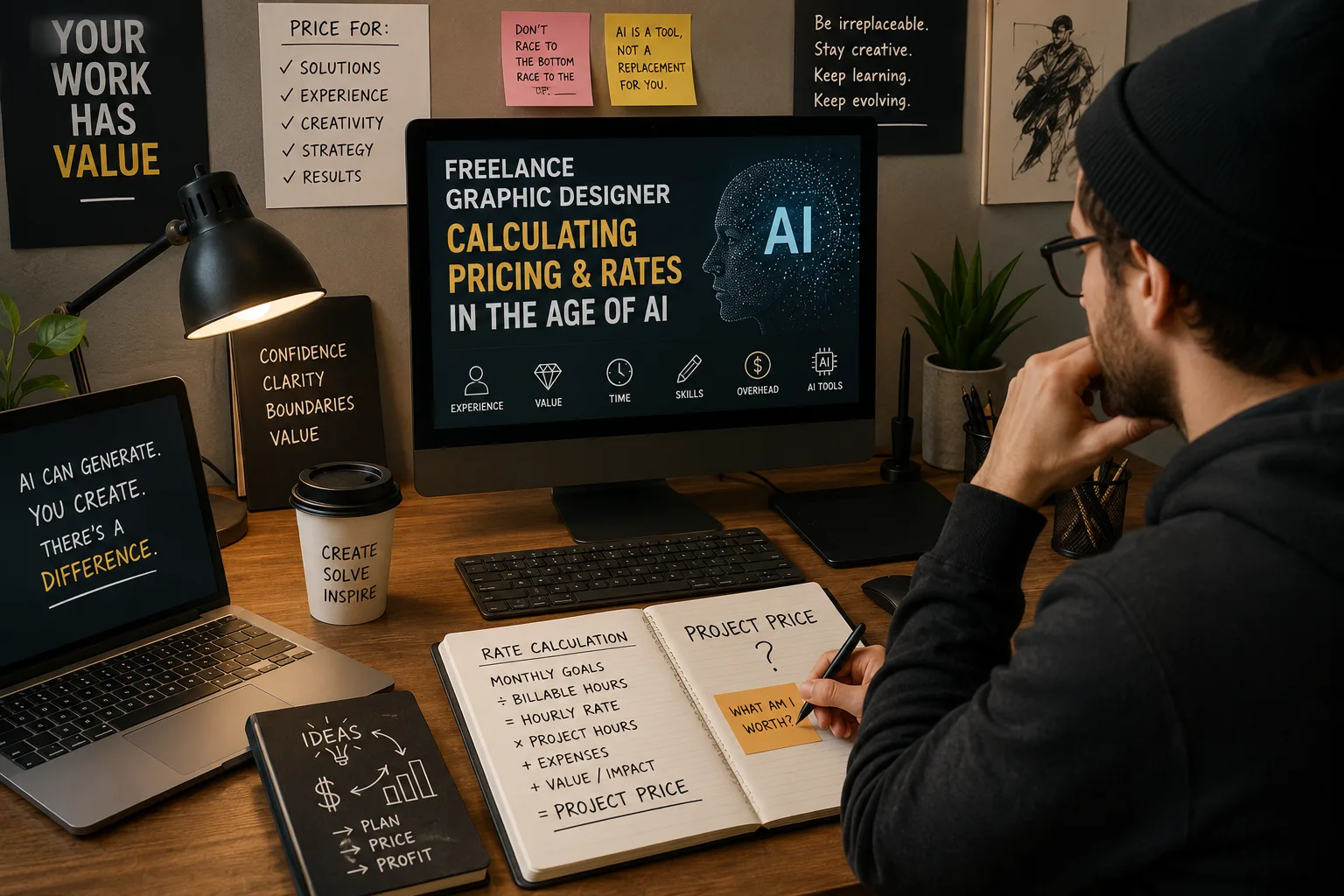
Figuring out how to price graphic design work in the age of AI really comes down to one decision: are you competing with the tool, or against everyone else who's afraid of it? If you're a graphic designer wondering what to charge now that clients can generate a rough logo or social template in Midjourney for free, you're not alone — and dropping your rates to compete with that is exactly the wrong move. The designers actually doing well in 2026 aren't pricing against AI. They're pricing above it, by charging for what AI still can't do: strategy, brand judgment, and the ability to actually talk to a client.
This article may contain affiliate links. If you make a purchase through one, The Artillerist may earn a small commission at no extra cost to you.
Why This Feels Different Than Past Pricing Anxiety
Designers have always second-guessed their rates. What's new in 2026 is the specific shape of the anxiety. Fast Company and AIGA surveyed nearly 1,300 freelance designers specifically because so many were turning to each other — rather than any single reliable source — for answers about what to charge, and found that a majority are now using AI tools often or sometimes in their own workflow, mostly for brainstorming and early drafts.
Advertisement
The bigger shift isn't designers using AI. It's clients using AI first, then hiring a designer to fix what it produced. As one analysis of the freelance design market put it, designers across Reddit, Dribbble, and LinkedIn are describing the same pattern: clients generate something mediocre with AI, then expect a designer to polish it for a fraction of what original creative work used to cost. That turns design into a correction service instead of a creative one, and it's the single biggest driver of the "what do I even charge" question right now.
The Biggest Mistake: Discounting Because of AI
If a client says "AI can basically do this now," the instinct is to lower your price to stay competitive. Resist it. Cutting your rate in response to that argument doesn't make you more competitive — it trains that client, and every client after them, to expect an AI discount permanently. Once a category's price anchors down, it rarely comes back up. The designers holding their rates steady in 2026 are treating AI the way earlier generations treated stock photography or templates: a tool that changes how they work, not proof that the work itself is worth less.
How the Market Is Actually Splitting
The data backs up what this feels like anecdotally: 75% of designers are now using AI tools in some form, but that hasn't collapsed demand — it's split it into two very different tiers.
- Commodity work — basic logo variations, simple social templates, straightforward product mockups — is now genuinely well-served by AI tools directly, and pricing here is falling fast because clients can get "good enough" for free or near-free.
- Specialist work — brand identity systems, packaging, creative direction, and anything requiring real client communication and strategic judgment — is holding steady or growing, because none of that is something a prompt can do on its own. A client can generate a hundred logo variations in an afternoon, but they still can't generate the judgment call about which one actually fits the brand, or the conversation that gets a nervous stakeholder to sign off on it.
The practical takeaway: if most of your work has lived in that commodity tier, 2026 is the year to move up rather than compete on price. If you've read our piece on why great art isn't enough anymore, this is the same visibility-and-differentiation problem, just showing up as a pricing problem instead of an audience problem.
Practical Pricing Moves for 2026
- Price the outcome, not the hours. Outcome-based pricing — also called value-based pricing — means charging a flat fee for the finished deliverable itself, rather than billing for the hours it took to produce it. If AI lets you finish a logo concept in 20 minutes instead of 3 hours, hourly billing punishes your own efficiency. Flat, outcome-based pricing lets you keep the value you create instead of passing your speed gains straight to the client.
- Write AI into your contract, explicitly. State what's AI-assisted and what isn't, and treat "polish my AI output" requests as a distinct, separately priced service rather than a quick favor.
- Fight scope creep with a real change-order process. The line "can you also just quickly add..." has quietly eaten more freelance profit than almost anything else. A simple rule — anything outside the original brief gets a separate quote — protects your pricing far more than raising your base rate does.
- Niche toward judgment, not just execution. The tighter your specialty — packaging for food brands, editorial identity systems, whatever it is — the harder you are to replace with a general-purpose tool.
Here's how the two billing models actually compare once AI is part of your workflow:
| Hourly Billing | Outcome-Based Billing | |
|---|---|---|
| You're paid for | Time spent | The finished deliverable |
| When AI speeds you up | Your invoice shrinks | Your invoice stays the same |
| What the client sees | A line item of hours worked | A price for the result |
| Best fit in 2026 | Undefined or evolving scope | Clearly scoped projects |
For a closer look at how this plays out for artists selling finished pieces rather than client services, our guide on pricing your artwork covers the same underlying principle from the other side of the business.
Worth Watching
This video walks through an actual numbers breakdown that pairs well with the framework above — useful if you want to see the math behind moving from a rate that "felt right" to one you can defend: What Should I Charge as a Freelance Designer? Real Costs Breakdown
Frequently Asked Questions
Should I lower my rates because clients can use AI now? No. Discounting trains clients to expect an AI-driven price cut permanently, and it doesn't actually make you more competitive — it just anchors your entire category lower.
What should I charge for "fixing" AI-generated design work? Price it as its own service, not a quick favor. Cleaning up someone else's AI output to make it usable often takes real skill and judgment, and should be quoted separately from a from-scratch project.
Is AI actually reducing demand for graphic designers? Not overall — it's redistributing it. Commodity-level work is shrinking, while brand strategy, packaging, and creative direction are holding or growing in value.
How do I know if I'm in the "commodity tier" that's shrinking? If a client could plausibly get 80% of the way to your deliverable with a free AI tool and a few prompts, you're in it. The fix isn't working faster — it's moving toward work that requires judgment a prompt can't replicate.
Does this mean I should stop using AI tools myself? No — using AI to speed up your own process is different from a client using it instead of you. Designers pricing well in 2026 use AI internally to work faster, then still charge for the judgment and strategy layered on top, rather than passing those efficiency gains straight to the client as a discount.
Bottom Line
The "what should I even charge anymore" question isn't really about AI making designers obsolete — it's about the bottom of the market getting genuinely automated while the top of the market gets more valuable, not less. Pricing scared, by discounting to compete with a tool, is the one move that guarantees you end up on the wrong side of that split.
Our recommendation: default to outcome-based pricing, quote any AI-cleanup work as its own line item separate from original design work, and never discount specifically because a client brought up AI. That last habit alone protects your rates more than anything else on this list.