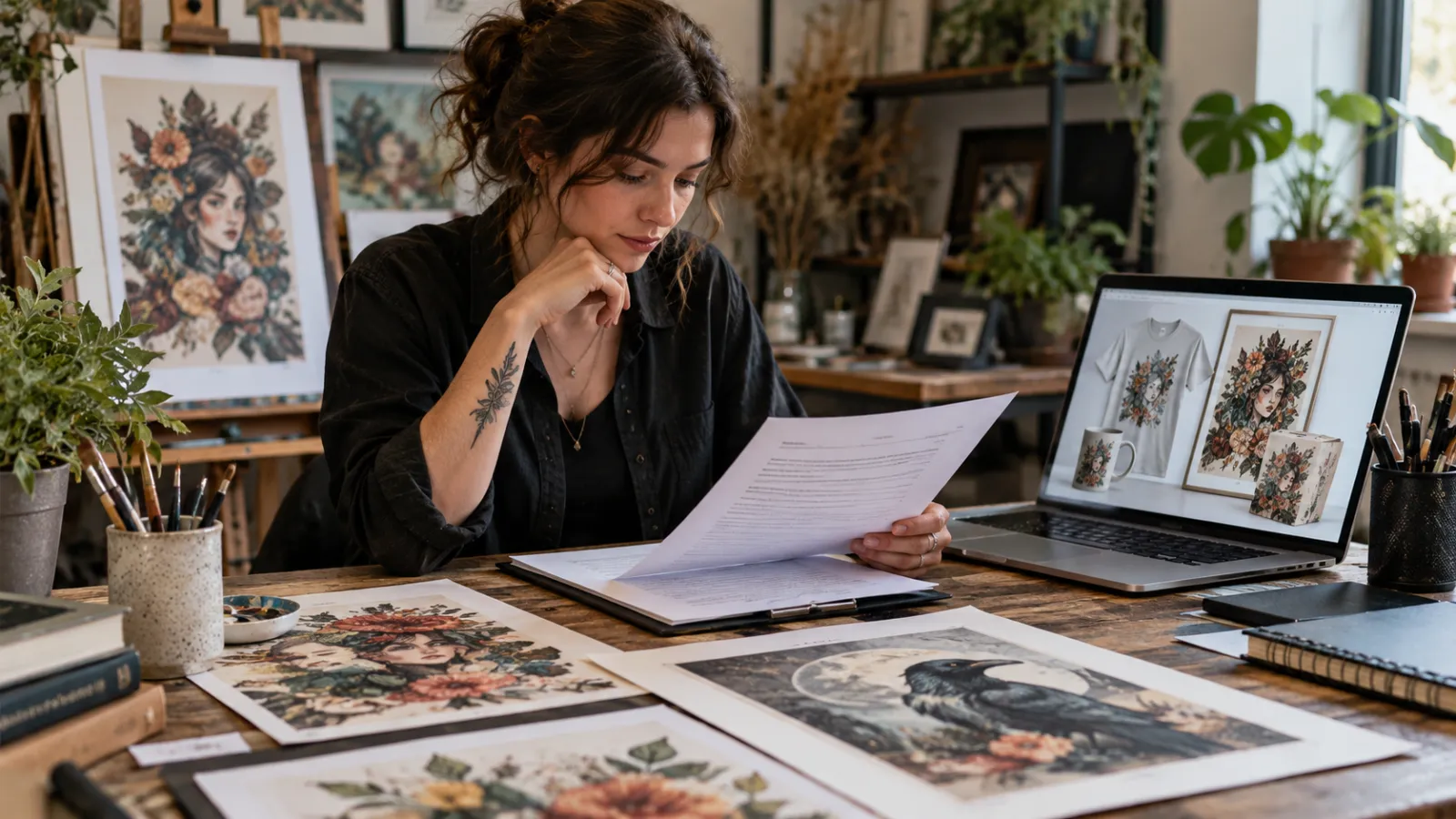
Art licensing for artists is a way to earn money by giving another person or company permission to use your artwork for specific purposes without necessarily selling your copyright.
A single illustration, painting, pattern, photograph, or digital artwork could potentially be licensed for clothing, books, packaging, advertising, prints, home decor, games, stationery, or other commercial products.
The artist may receive a flat licensing fee, royalties, an advance, or a combination of payment methods.
Advertisement
Quick answer: For most independent artists, the best starting approach is to retain copyright when appropriate and license only the specific rights a client actually needs. Define the usage, territory, duration, exclusivity, payment, and ownership terms in writing before delivering production-ready artwork.
Understanding these rights matters because creating the artwork and granting someone permission to commercially exploit it are not necessarily the same transaction.
This guide explains how art licensing works in 2026, what artists can license, how artists get paid, how licensing prices are determined, what should appear in an agreement, how licensing compares with selling copyright, and what artists should know about emerging AI-related licensing.
Art Licensing for Artists: Key Takeaways
If you remember only a few things from this guide, remember these:
- Licensing usually involves granting permission to use artwork rather than automatically transferring copyright.
- Usage, territory, duration, distribution, and exclusivity can all affect the value of a license.
- A creative fee and a commercial licensing fee can represent two different types of value.
- Flat fees and royalties are both possible payment models.
- Exclusive rights should generally cost more than comparable non-exclusive rights because they can restrict future opportunities.
- A client asking for "all rights" may actually need something much narrower.
- Significant licensing agreements should be documented in writing.
- Artists should keep records of every active license.
- AI training, dataset use, retrieval, and generative use should not automatically be treated as one broad category called "AI rights."
- For substantial agreements, professional legal advice may be worthwhile.
What Is Art Licensing?
Art licensing is an agreement in which the copyright owner gives another person or business permission to use artwork according to specific conditions.
The artist can potentially retain ownership while granting limited commercial rights.
Imagine that you create an illustration of a skull surrounded by roses.
A clothing company wants to print the illustration on T-shirts.
Instead of selling the company your entire copyright, you might license it permission to reproduce that image on T-shirts for a defined period.
The agreement could specify:
- T-shirts are the permitted product
- The license lasts two years
- Sales are limited to North America
- Production is limited to an agreed quantity
- The image cannot be used on other merchandise
- Modifications require artist approval
- The artist retains copyright
- The artist receives a licensing fee or royalty
That is very different from permanently transferring every copyright right associated with the artwork.
Art licensing is essentially the business of defining and selling permission.
Do Artists Own Copyright to Their Artwork?
In the United States, qualifying original visual artwork is generally protected by copyright when it is created and fixed in a tangible medium.
That can include:
- Paintings
- Drawings
- Illustrations
- Photography
- Graphic art
- Digital artwork
- Sculptures
- Prints
- Other qualifying visual works
The U.S. Copyright Office explains that copyright protection generally exists from the moment an original work is fixed. Registration is not required for copyright to exist, although registration can provide important additional legal benefits.
Artists can learn more through the U.S. Copyright Office guide for visual artists.
Copyright ownership can become more complicated when artwork is created:
- As part of employment
- Under a work-made-for-hire agreement
- As a collaboration
- After signing a copyright assignment
- Under certain commissioning arrangements
That is why artists should read contracts carefully instead of assuming they will always retain every right.
Art Licensing vs. Selling the Original Artwork
One of the most important concepts for artists is the difference between the physical artwork and the intellectual-property rights attached to it.
Suppose you sell an original painting to a collector.
The collector owns the physical painting.
That does not automatically mean the collector acquired every copyright right associated with the image.
Depending on the agreement, the artist may potentially retain rights to reproduce or license the image for:
- Art prints
- Posters
- Books
- Clothing
- Packaging
- Advertising
- Calendars
- Greeting cards
- Other commercial uses
This means one piece of art can potentially produce more than one type of income.
If you are also trying to determine how much to charge for the physical artwork itself, read How to Price Your Artwork in 2026.

What Rights Can an Artist License?
Art licensing becomes easier to understand when you break a license into individual rights.
Usage
Usage describes what the company is allowed to do with the artwork.
Examples include:
- Apparel
- Packaging
- Books
- Posters
- Advertising
- Editorial publications
- Websites
- Greeting cards
- Games
- Home decor
- Stationery
- Album covers
- Product labels
- Social media campaigns
A company that needs an illustration for a book cover does not necessarily need permission to put the same illustration on T-shirts.
Those can be two separate licenses.
Territory
Territory determines where the artwork can be commercially used.
Examples include:
- United States
- North America
- Europe
- Specific countries
- Worldwide
A worldwide license may have greater commercial value than a license covering one local market.
Duration
Duration determines how long the license lasts.
Common structures might include:
- Six months
- One year
- Two years
- Five years
- Perpetual
Artists should be especially careful with perpetual rights because the permission may continue indefinitely.
Distribution
A license can limit the number of products or the size of the campaign.
Examples might include:
- 500 posters
- 5,000 shirts
- 20,000 books
- One advertising campaign
- A defined number of product units
Modification Rights
A business may want permission to:
- Crop artwork
- Change colors
- Add typography
- Resize the image
- Animate portions of the work
- Combine the art with other graphics
Artists who want creative control should define what modifications are allowed.
Sublicensing
Sublicensing determines whether the licensee can give another company permission to use your work.
This can significantly broaden how the artwork is distributed, so it deserves careful attention.
Exclusive vs. Non-Exclusive Art Licensing
The difference between exclusive and non-exclusive licensing can dramatically affect both price and future opportunities.
| Non-Exclusive License | Exclusive License |
|---|---|
| Artist may license other compatible uses | Licensee receives exclusivity within an agreed scope |
| More flexibility for the artist | May restrict future deals |
| One artwork can potentially generate multiple licenses | Exclusivity can increase the license's value |
| Useful for diversified licensing | Scope must be carefully defined |
What Is a Non-Exclusive Art License?
A non-exclusive agreement can allow an artist to license the same artwork to multiple companies as long as the rights do not conflict.
For example:
Company A → greeting cards

Company B → book cover

Company C → wall art

Company D → puzzles